Emma Duggan
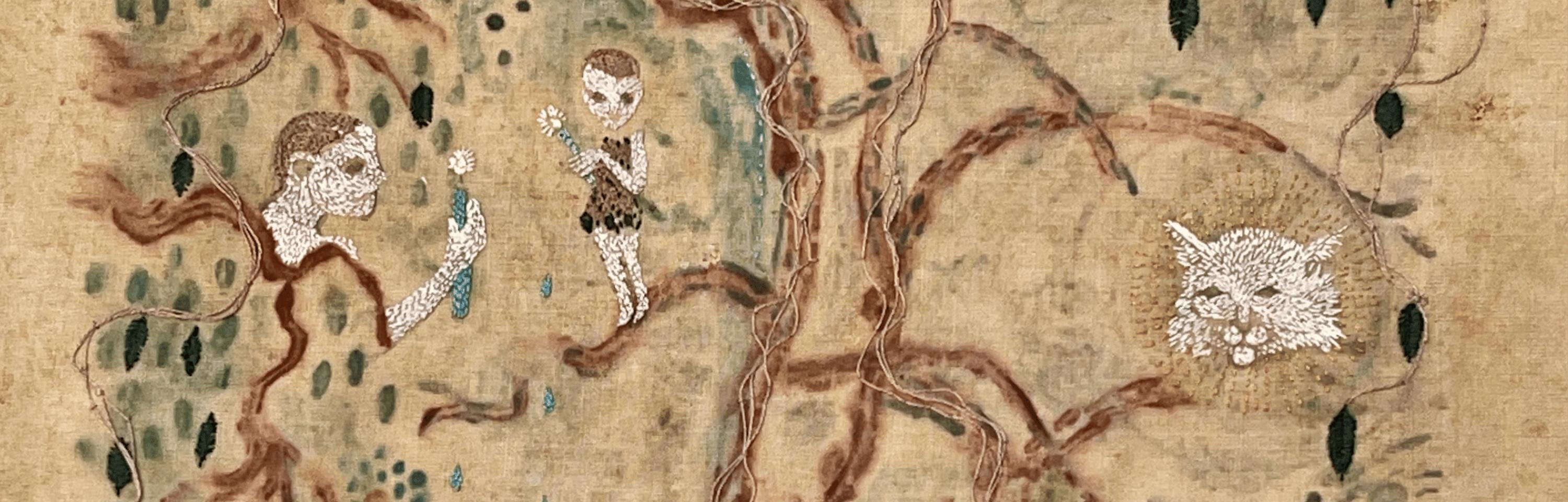
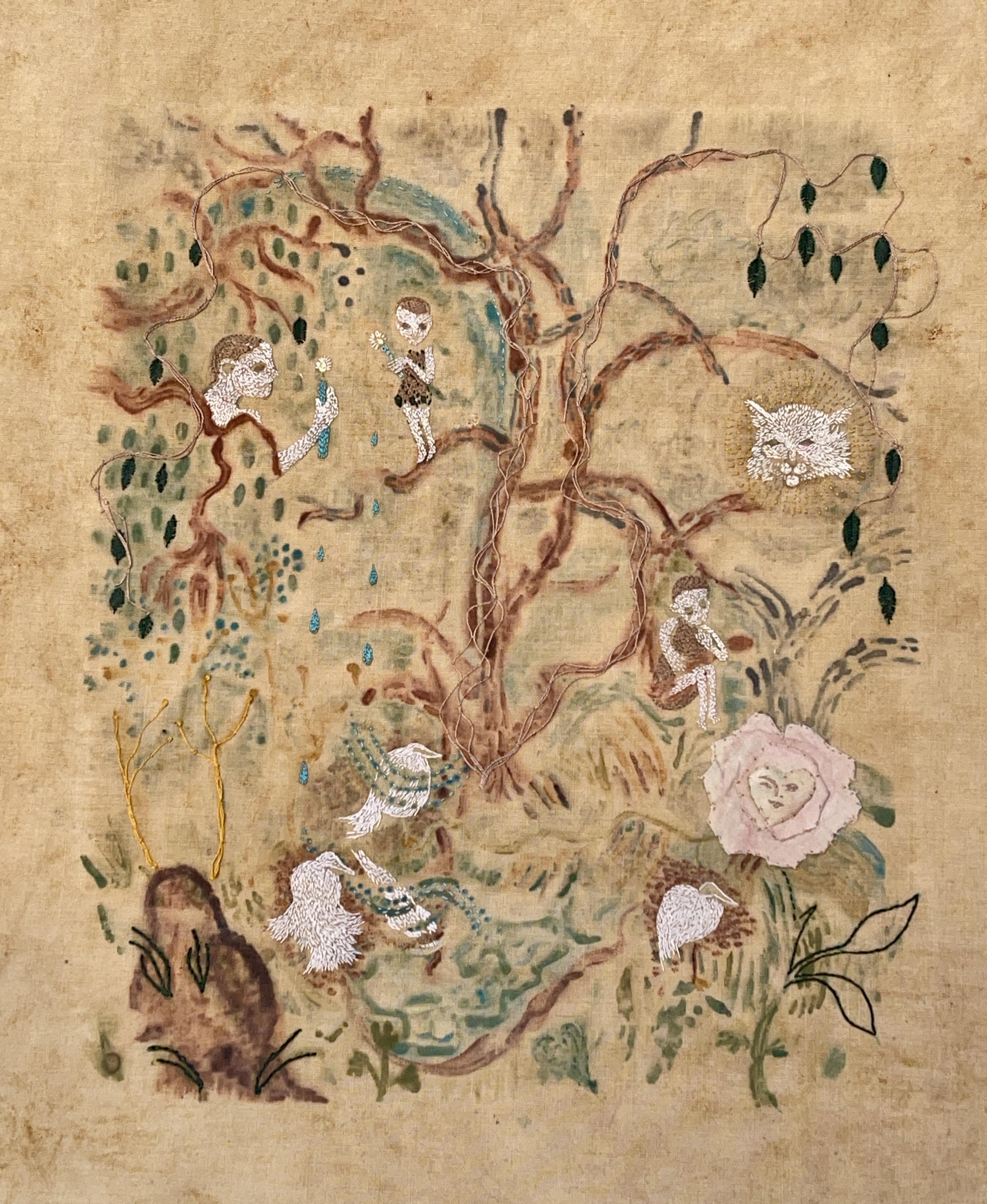
Storm Candle, 2026
Monoprint with embroidery & applique on plant-dyed fabrics (Alder & Amaranth)
22 x 32cm
What was the dream-like experience that inspired your piece?
On a morning of February, in the winter sun, I made some drawings and paintings of the lake and river nearby, with the visiting egrets and first shoots of wild garlic. That same night, I'd had dreams about a body of water resembling the lake and the dream drawing merged with the lake drawing in my sketchbook. This often happens: the dream drawing aligns with something seen in the conscious waking time (especially around the new or full moon). This can appear in the form of synchronicities or patterns.
This drawing became the inspiration for the piece Storm Candle. In the dream, two boys and a Marian or water goddess figure were all holding candles, from which the wax dripped into the lake, creating feathery shapes as it solidified, much like the shape of the egrets. The dream was recorded around Candlemas in February and around the time of the full moon in Leo, 2025.
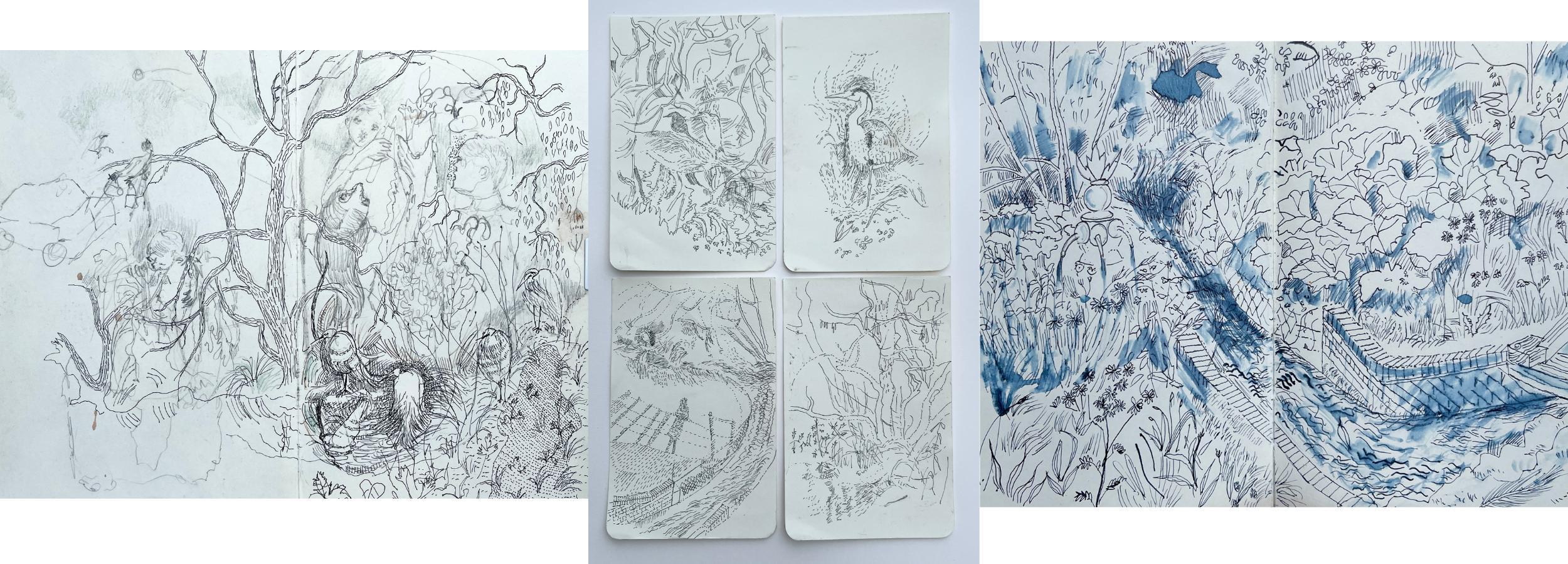
To capture dreams like this before they fade, I keep a sketchbook close by and draw as soon as I wake up, even if it's just an outline or a few words. I also carry my book with me everywhere and capture something from my daily life. Two sets of drawings from the journey taken at both night and day, which can sometimes merge or overlay and suggest a third space in between: a place to channel between worlds.
Dreams and the unconscious are at the heart of this art competition. How does that territory relate to your practice more broadly?
While studying magic and spirituality, I came across the notion of 'Solve et Coagula'; that dream records can be part of a de-conditioning process, where the lead of suffering and ego are turned into the gold of illumination. Initially, I recorded my dreams in words but, over time, I began to draw them. Sitting with these unremembered and mysterious melancholic fragments and celebrating with them was leading me through to a kind of awareness. Sometimes, there are elements of my dreams that also end up being prophetic.
For me, dreams offer a door into an uncharted reality where we are able to access deeper levels and insights. This parallels other ways of awareness in the waking worlds, such as developing a sympathy with plant and animal consciousness. While making art, I bypass time and the conscious mind and recall dreamlike states. I add layers in the work by 'scrying' into non-intentional marks and combining them with intentional imagery like the overlay effect of dream and waking spaces. In Storm Candle, particularly, the subconscious and conscious seem to be almost composites, an overlay of the same space.
I have been keeping dream diary drawings for a few years and water is a strongly recurring theme. In a dream symbol workshop I took part in, I learned that Jung believed that bodies of water represented the unconscious, to me dreaming of water is so much more than a metaphor; it speaks to the substance and quality of the psyche. The appearance of a young man, is said by Jung to be a sign of the unconscious creative function in women.
What drew you to enter this art competition at The College of Psychic Studies?
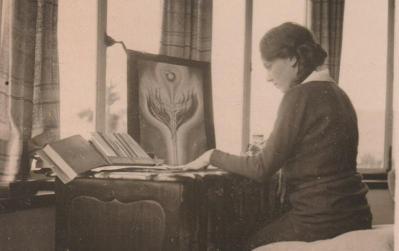
My own relationship to artists who channel the unseen started when I studied the worlds of outsider artists like Madge Gill as a student of textiles, where I felt a sympathy between their work and my own and the backgrounds of some of the artists. The Medium is the Message exhibition really spoke to me and I felt as if my practice chimed in with "themes of spirit communication, ancestral memory and the energetic connection between the body, Earth and unseen realms" as the exhibition was described. I felt as if my practice lends itself to what the college stands for and the Dreams art competition seemed particularly to speak to me.
Increasingly, I feel that the ideas appearing to me are more channelled than consciously planned and intentional pieces. I let elements of the work happen spontaneously rather than solely to pre-order and plan things, and it seems to come from a threshold space.
The ethos of the college holds space beautifully for these kinds of concepts that exist in my work and practice. "Artist as the Channel between worlds as a receiver of visions, energies and ideas" (from The Medium is the Message) and especially channelling the work of women as visionaries.
I was excited to see the work brought together for The Medium is the Message, which included the work of artists' work I aspire to and admire.
Are you someone who plans meticulously or do you let the work lead you?
At the heart of my work is the small sketchbook which I keep with me. This allows me to create a personal language to use in my works. Some of the imagery in my work is conscious and intentional, but some happens spontaneously and feels as if it is a kind of channelling. The notes in the sketchbook can be the starting point or they can form part of another piece. Sometimes, the story of the work in my mind is being told concurrently with the making of the work by my hands. I'll layer intuitively, taking suggestions from scrying into surfaces of non-intentional marks, and these will collide with intentional collected imagery in unexpected ways, creating new paths and journeys. Most of my working processes deliberately allow for the work to lead me. I create layered surfaces which can be drawn out into further definition, depending on what the marks suggest. I add stitched layers spontaneously over works which have been painted. I add collage and appliqué to define suggested shapes. The figure appearing as a rose, the symbol of Mary and of the Venusian, was unplanned in the original, but it seemed to 'grow out' of the work as I looked into it.
Where do you find your creative nourishment?
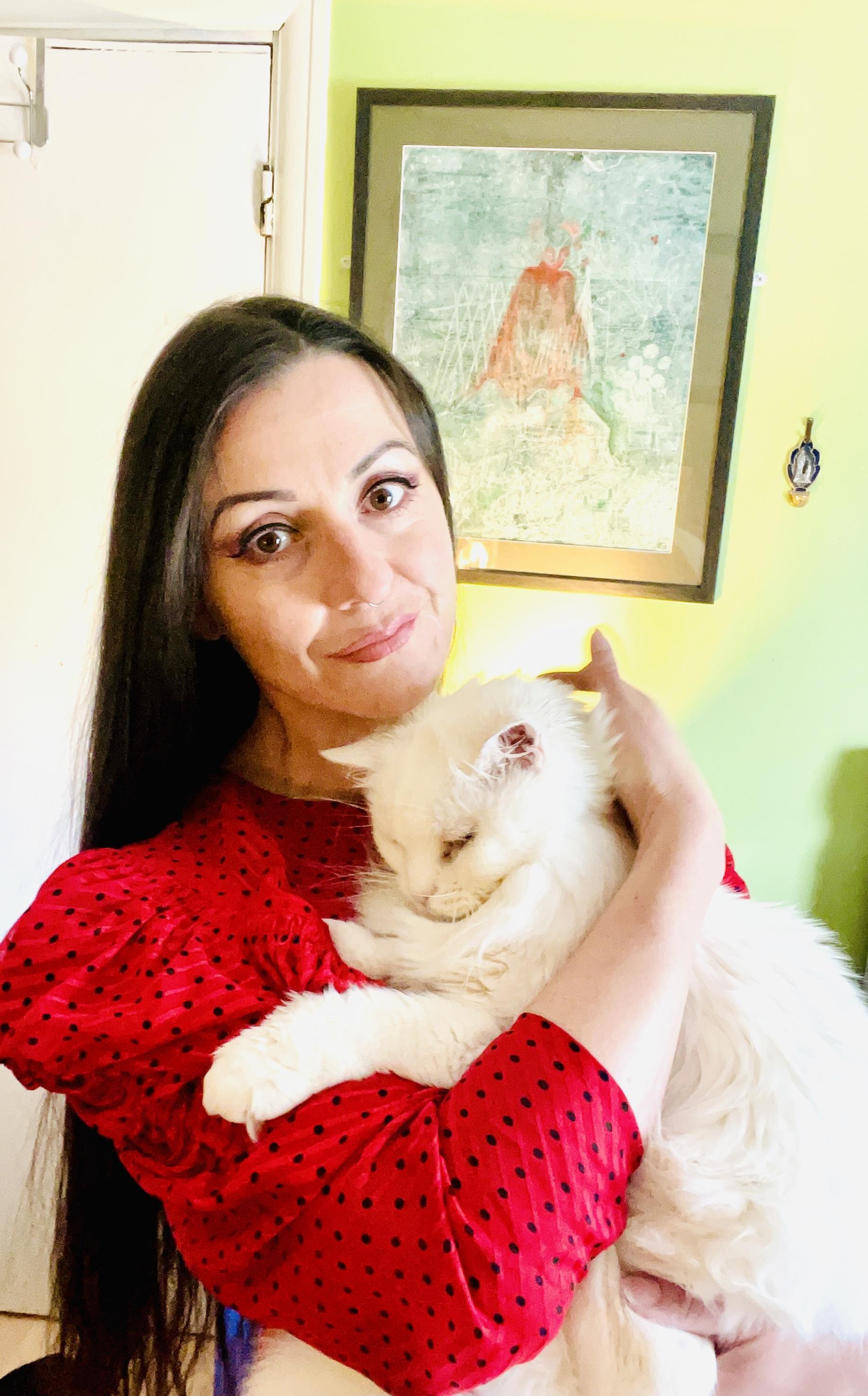
The natural world, animals and dreams are all sources of nourishment and inspiration for me. I like to make plein air paintings of the area in which I live or visit, and also grow plants and make dyes for inks and fabrics, feeling that wild colour dyed from my land also has a special potent magic of its own as well as being loved for the colour it provides. Nature, the esoteric and art all seem to inform and nourish each other in my practice.
**I love reading books which explore the imaginal realm such as Glennie Kindred's books on The Ogham. The medieval idea of the Hortus Conclusus is a theme I return to as a mythical healing space without and within. I am also interested in alchemical illustrations and diagrams. Other artists who inspire me are Leonora Carrington and Madge Gill. I often work alongside my cat, who is a constant source of inspiration and companionship and often appears in my works as a character. In the studio, I listen to instrumental music like Laura Cannell.
What are you working on next and where can people follow your journey?
I am creating a series of embroidered paintings on dyed fabrics, of which Storm Candle is one and I also regularly make new paintings and drawings on paper. The next piece in the series is a Hawthorn themed stitched painting. My dream journal is an ongoing practice at the heart of all my work.
I am also creating a body of work which centres around visionary experiences that connect with water, dreams and nature.
My work will next be shown at Svnth Circle Gallery, Bowyer Street, Digbeth, Birmingham from 01/05-29/5/2026 at the group show Beauty and the Beast. I will be showing three paintings which speak of both the dual nature of dreaming into the landscape and is also the theme of the show celebrating the dual nature of Birmingham as a city.
I update my latest news on my Instagram page @e.j.duggan where all my projects and shows and ongoing works are posted.
Additional Notes:
*(The City of Birmingham still retains some of its former forest of Arden characteristics with its many trees and green spaces.)
Poly-Olbion, a topographical poem describing England and Wales. Authored by Michael Drayton (1563–1631) and published in 1612
He describes the Forest of Arden as being located between the River Severn and the River Trent:
Muse, first of Arden tell, whose footsteps yet are found
In her rough woodlands more than any other ground.
That mighty Arden held, even in her height of pride;
Her one hand touching Trent, the other, Severn's side.
The very sound of these, the Wood-Nymphs doth awake:
When thus of her own self the ancient Forest spake
**Books I have read that have inspired my work
Trees of The Goddess by Elen Sentier
Nature Spirits and Elemental Beings by Marko Pogacnik
The Secret Commonwealth by Robert Kirk
The Goddess The Grail and the Lodge by Alan Butler
Walking With Trees by Glennie Kindred
See all the results of The College of Psychic Studies annual art competition here.
The competition is open to all and free to enter.
Stay tuned to the newsletter for updates on the next art competition.