Uwe Henneken
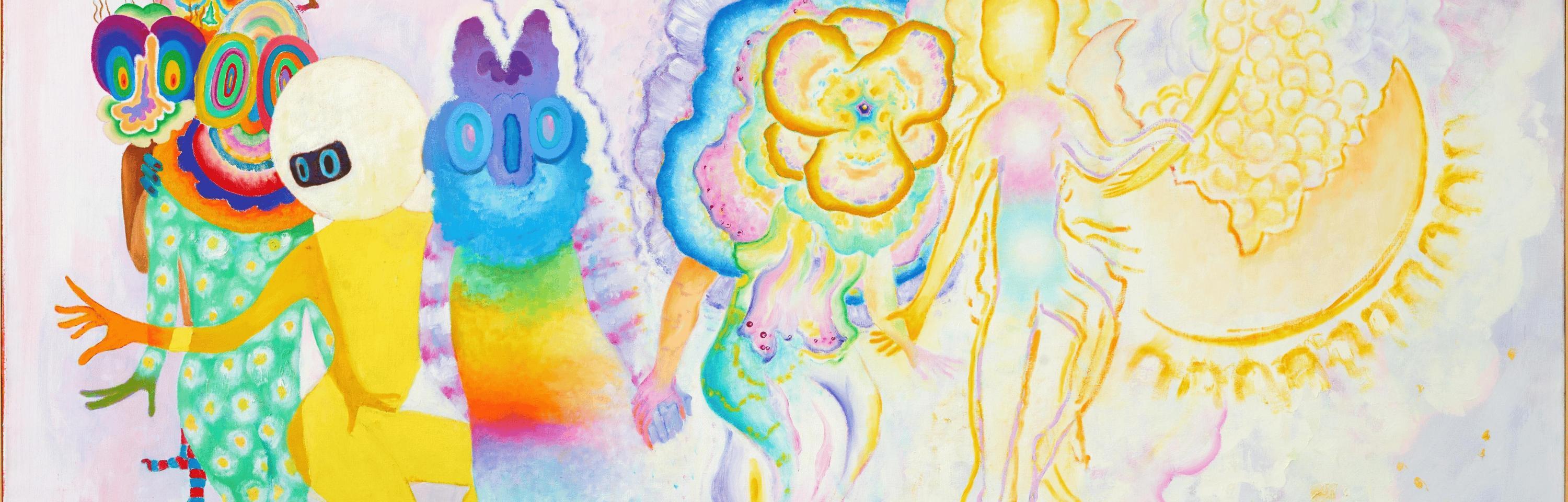
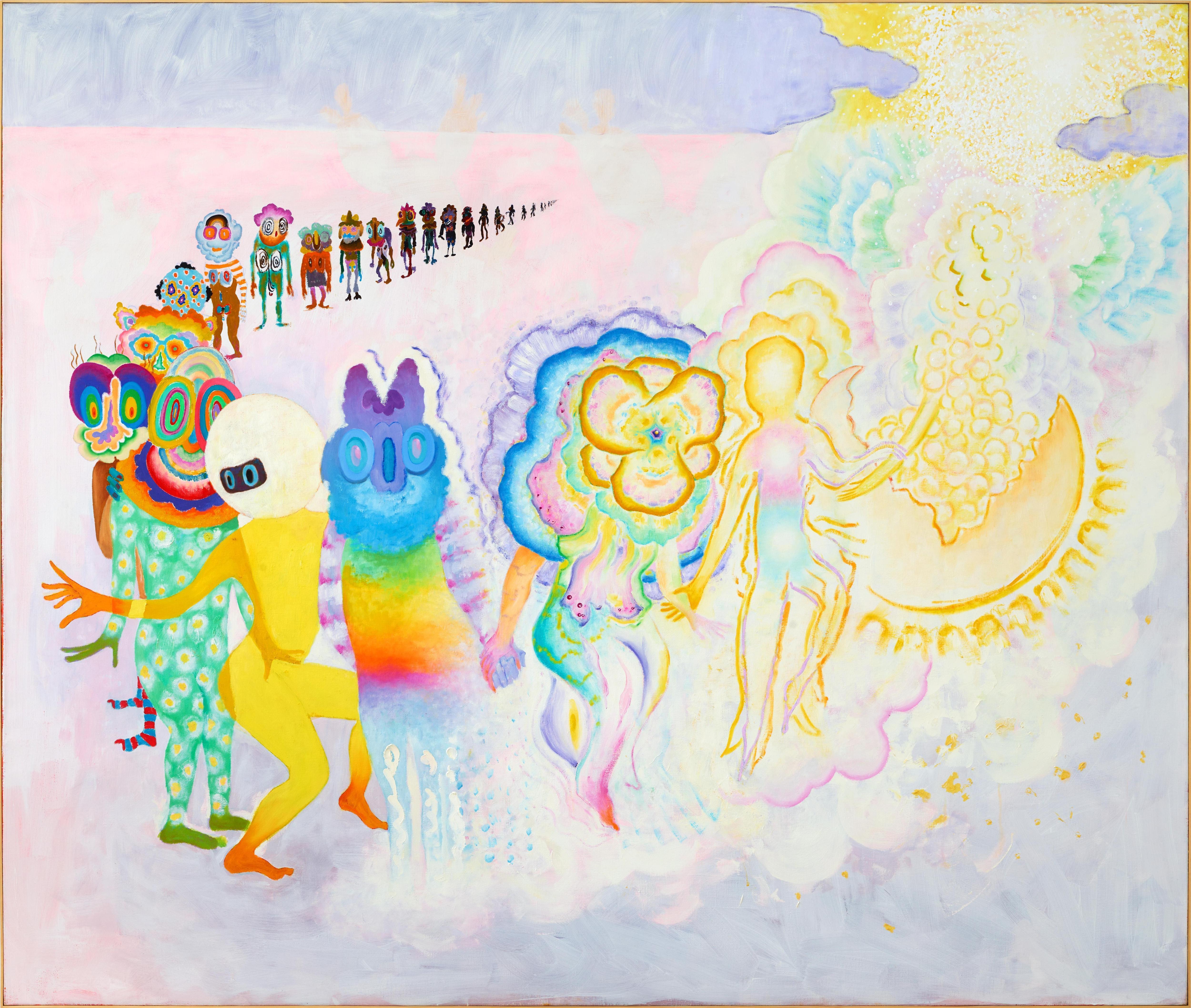
Transformation People, 2016-2024
Oil on canvas
220 x 260cm
What was the dream that inspired your piece, Uwe?
Rather than emerging from a single dream, the painting grew out of a long and uncertain period surrounding my mother's cancer diagnosis.
In 2017, before a major operation, I felt compelled to begin a painting for her, without knowing where it would lead. As I worked, a procession of figures appeared: small dark forms emerging from a luminous distance, gradually becoming colourful and fully embodied before dissolving again into light. Looking back, it feels like a meditation on incarnation, transformation and return, although I did not consciously set out to paint those themes.
I painted roughly half of the work before suddenly feeling I had to stop. Shortly afterwards, my father called to say that the operation had gone well. The painting then remained unfinished for many years. I completed it only in 2024, and my mother passed away in 2026.
The painting accompanied that journey for almost a decade. Rather than capturing a dream before it faded, the work itself became a vessel that carried an experience I could not yet fully understand.
Dreams and the unconscious are at the heart of this art competition — how does that territory relate to your practice more broadly?
The unconscious is both a source and a subject of my work.
Many paintings begin with fleeting perceptions: something glimpsed out of the corner of my eye, a dream fragment, a memory, an atmosphere or an image that appears before I fully understand it. I have always experienced a certain permeability to images and visual associations. Sometimes a small visual impression can unfold into years of artistic exploration.
I am interested not only in these images themselves, but also in developing a conscious relationship with them.
My practice is partly about creating the conditions in which such images can emerge and be received consciously.
Painting allows me to stay with such impressions long enough for them to unfold. Rather than analysing them, I try to listen to them.
I often feel that my task is not to impose meaning on an image but to become a receptive channel for something that is already seeking form. The process is less about control than about attention, trust and listening.
What drew you to enter an art competition held at The College of Psychic Studies?
I was drawn to the competition because the College occupies a rare and valuable space in contemporary culture.
It acknowledges that human experience is larger than what can be measured or explained through rational thought alone. Intuition, imagination, dreams and symbolic perception have always played an important role in my life and work.
I feel that institutions such as the College preserve something that modern culture has largely forgotten. We devote enormous attention to the rational and measurable and even trust AI more than our gut feeling, yet many meaningful experiences emerge through intuition, dreams, imagination and encounters with mystery.
I believe that children naturally possess a much more immediate openness to these dimensions, whereas adults often learn to distrust or suppress them. Art offers a way back — not to naivety, but to a more conscious relationship with those deeper layers of experience. Also not to become less rational, but more fully human.
That is the main reason why I feel such affinity with the questions the College has explored for more than a century.
How would you describe your creative process?
I rarely begin with a fixed plan.
Usually, there is an image, a colour, a visual fragment or a feeling that draws me into the work. Sometimes these arrive unexpectedly and insist on my attention. Rather than imposing a concept, I enter into a conversation with the painting and allow it to reveal itself over time.
I have learned not to ask too quickly where an image comes from. My task is first to meet it, work with it and see where it leads.
Intuition plays an important role, but it is supported by many years of practice and experience. The work is not random; it emerges through a conversation between conscious decisions and something less predictable.
In many ways, I feel that I follow the painting more than I lead it. Its something like becoming a channel.
For me, painting is a process of listening as much as making.
Where do you find your creative nourishment?
Nature and imagination remain my greatest sources of nourishment.
Living on a small island in Denmark, I spend a great deal of time observing landscapes, weather, light and seasonal change. I am constantly reminded how fortunate I am to be surrounded by nature and long rhythms of seasonal change.
These experiences continually find their way into my work, not necessarily as direct representations, but as atmospheres, spatial feelings and states of perception.
More broadly, I am drawn to experiences, places and artworks that expand perception and invite a sense of wonder. I find myself returning again and again to moments where the visible world seems to reveal something beyond itself.
What are you working on next, and where can people follow your journey?
I am currently working on several new groups of paintings and continuing my long-term exploration of imagination, transformation and the relationship between the visible and the invisible.
Alongside my studio practice, I am increasingly interested in projects that bring painting into dialogue with landscape, ritual and shared experience.
People can follow my work through my website and Instagram: www.uwehenneken.net @uwehenneken
See all the results of The College of Psychic Studies annual art competition here.
The competition is open to all and free to enter.
Stay tuned to the newsletter for updates on the next art competition.