Have you ever seen a film that stayed with you long after the end titles rolled? The kind of film that stirs you deeply in a way that makes no obvious sense, as it has no real relation to your life at all. The kind of film where you find yourself inexplicably drawn to one particular character, not necessarily the main protagonist, more than all the others.
What was the first film and character you thought of?
Now what about history – which era, which part of the world draws you? Not just as an interest, but as something more felt than that. The kind of pull where you can almost imagine yourself living in that time and place.
What was the period and place in history that came to you first?
It's possible that whatever arose is an old story thread sitting quietly in the background of your conscious self. Anything that produces a reaction – a body sense, an image, a symbol – holds the potential for a story behind the story. Something else worth pondering: why did your psyche, out of hundreds of thousands of possibilities, choose that particular film character, and that place and time in history? Both, as it turns out, offer healing for wounds of the soul.
The method and its maker: Introducing Deep Memory Process
Deep Memory Process (DMP) was created by Jungian analyst Roger Woolger. Roger was a true pioneer in past-life regression, and what set his DMP method apart was that it was the first to bring the physical body into the work. He was also the first to show that these unfinished stories weren't buried deep and inaccessible – they were just out of sight of conscious awareness, and all that's required to reach them is the ability to imagine. DMP treats the everyday as a potential doorway into other lives and opportunities for deep healing.
The trance we're already in
In today's world, we are more in a constant state of mild trance than at any other point in human history. Every time you look at a screen, you are somewhere else — you are in an altered state. If you make that daily journey to work on the Tube or bus, lost in a podcast or a book, you are not present in your body. You are in a mild form of trance. Have you ever driven to a familiar destination without remembering a single turn – left at the traffic lights, straight across at the roundabout? Same thing. An altered state of consciousness.
DMP was created for exactly this – for the maladies of today's quietly "out of body" world. That's why we don't use hypnosis or anything like it for Deep Memory. We don't need to. Most people are already there.
When colour became a time traveller
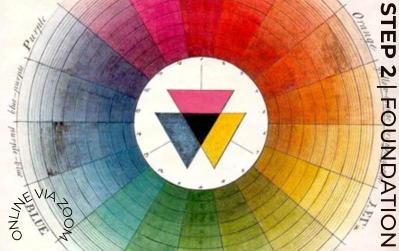
I've come to learn that colour is an extraordinary healer. But when colour is combined with DMP, it becomes an extraordinary time traveller too – and does a remarkable job of shapeshifting the roles we play deep within the psyche. One minute there's a dislike of red, then comes an angry, bloody red, and the next there's a young soldier taking his last breath in the trenches of the First World War.
It was after one too many spontaneous sessions like this that I realised I needed both a container and a structure for guiding these emerging stories – what I now call colour stories. And that's when Roger Woolger and Deep Memory Process walked onto the stage of my life.
There's an interesting side note to this. In 1990, ten years before I met Roger, I was in the bookshop Waterstones deciding whether to buy his book or another one, when a complete stranger stepped forward and tapped her right index finger firmly on Roger's book. She looked me directly in the eye and said, softly but with quiet certainty: "I'd buy this one if I were you. It might just change your life one day." And with that, she turned and walked away, and was never seen again. She was right. It did. He did. Angels and otherworldly guides show up in the most ordinary ways, at the most extraordinary moments.
What DMP Actually Does
What appealed to me about DMP was that it explores other lives as metaphors for healing the past, while at the same time helping us live more fully and more integrated in the here and now. The colours were very excited about this too – it would give them a chance to tell their timeless stories. They've been around a long time. They've been in many places, seen many things, and they are wonderful collectors of memories. Especially deep ones.
Carol and the soldier who never came home
Carol was that red WW1 soldier. She hadn't expected to be, and never thought she could be – until all the pieces of the puzzle began fitting together without her even trying. Her intention for the session was to understand a feeling she had carried for as long as she could remember: a feeling of being out of place wherever she was. Of not belonging anywhere.
Not belonging brought the colour red. And with red came an ache in her heart and a pain in her shoulder. The pain, as it transpired, was the machine-gun bullet. The ache was the longing for home that the young soldier knew, with terrible clarity, he would never see again.
He was seventeen or eighteen. Carol had left home at eighteen. His unfinished story had been quietly shadowing hers. She longed for home and would make the six-hour coach journey from university as often as she could, yet no matter how many times she went, nothing seemed to ease that deep and aching longing. This was a wound to the soul – one that bled through time and into Carol's life today.
Carol sat in the chair opposite me, eyes open, telling his story as though it were happening now. Together, we brought him home. To honour this young man and his story, Carol made a promise to have a Lancashire hotpot. It was his favourite home-cooked meal.
Over the weeks and months that followed, Carol noticed a new warmth and groundedness she hadn't realised was missing. She also noticed a calmness – which, again, she hadn't known was absent until it arrived.
When we heal the wounds of the soul by giving voice to stories from other lives and other selves, we don't only heal ourselves. We contribute to the healing of humanity as a whole.
If a film, a character, or a period in history surfaced for you while reading this – hold it gently. It may be trying to tell you something...

Join our newsletter to keep in touch with The College of Psychic Studies.