Throughout its long history, The College of Psychic
Studies has been home to some of the most influential
mediums of the last three centuries. In The Medium is the Message, two rooms
celebrated the lives and legacies of four renowned female
mediums—Geraldine Cummins, Madame d'Esperance,
Helen Duncan, and Eileen J. Garrett—all who were
closely associated with the College. Through archival
material and artefacts, audio recordings, and contemporary responses by artists Dronma, Susan MacWilliam,
Sarah Sparkes, and Shannon Taggart, these displays
explore the rich and complex histories of mediumship,
spiritual communication, and the role of women as
conduits between worlds.
Madame d'Esperance (Elizabeth Jane Puttock, 1848–1919)
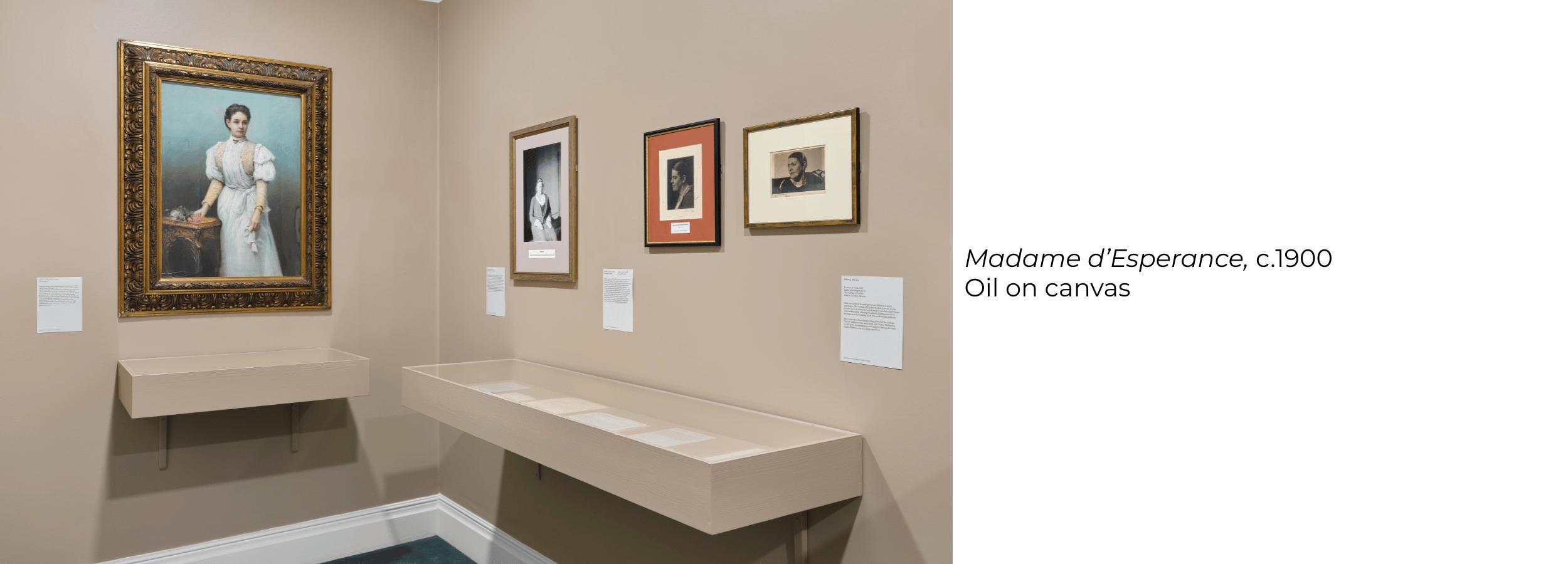
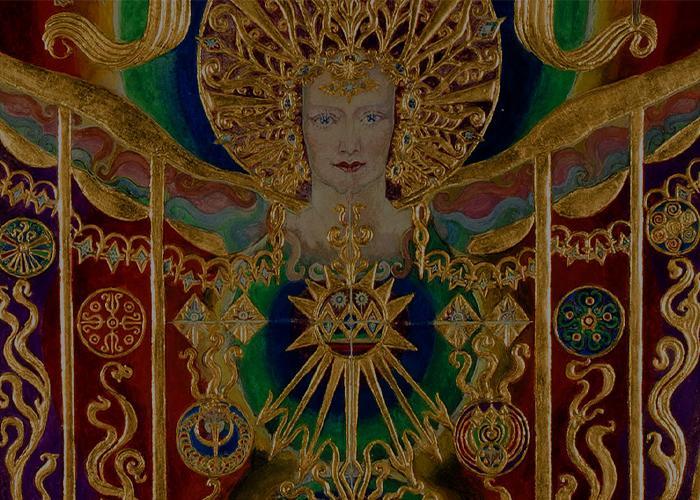
Madame d'Esperance (Elizabeth Jane Puttock, 1848–1919) was a renowned English spiritualist medium celebrated for her dramatic psychic phenomena, including materialisations, clairvoyance, and automatic writing. From childhood, she encountered vivid visions of 'shadow people' and unseen presences. Her mediumship began with table-rapping and evolved into full-form spirit apparitions that interacted with sitters and left physical traces. In séances, she famously materialised flowers, including a Golden Lily. These events, detailed in her memoir, Shadow Land, or, Light from the Other Side (1897), are commemorated in this painted portrait.
The College of Psychic Studies holds a significant archive of handwritten transcripts, artefacts, and letters by, and relating to, Madame d'Esperance. On display in a vitrine below Madame d'Esperance's portrait were a signed photograph addressed to her sister and a handwritten transcript of Materialisations, first delivered as an address to friends, members, and associates of the London Spiritualist Alliance on November 6, 1903. Later published in Light and as a booklet, the text explores the phenomenon of materialisation—where spirits are said to take on visible, tangible form. Madame d'Esperance describes her first experiences after six years of spiritual investigation, noting the dangers involved: 'I always felt I was placing my life in the hands of those assisting, who were even more ignorant of the danger than myself.'
Eileen J. Garrett & Mercy Phillimore
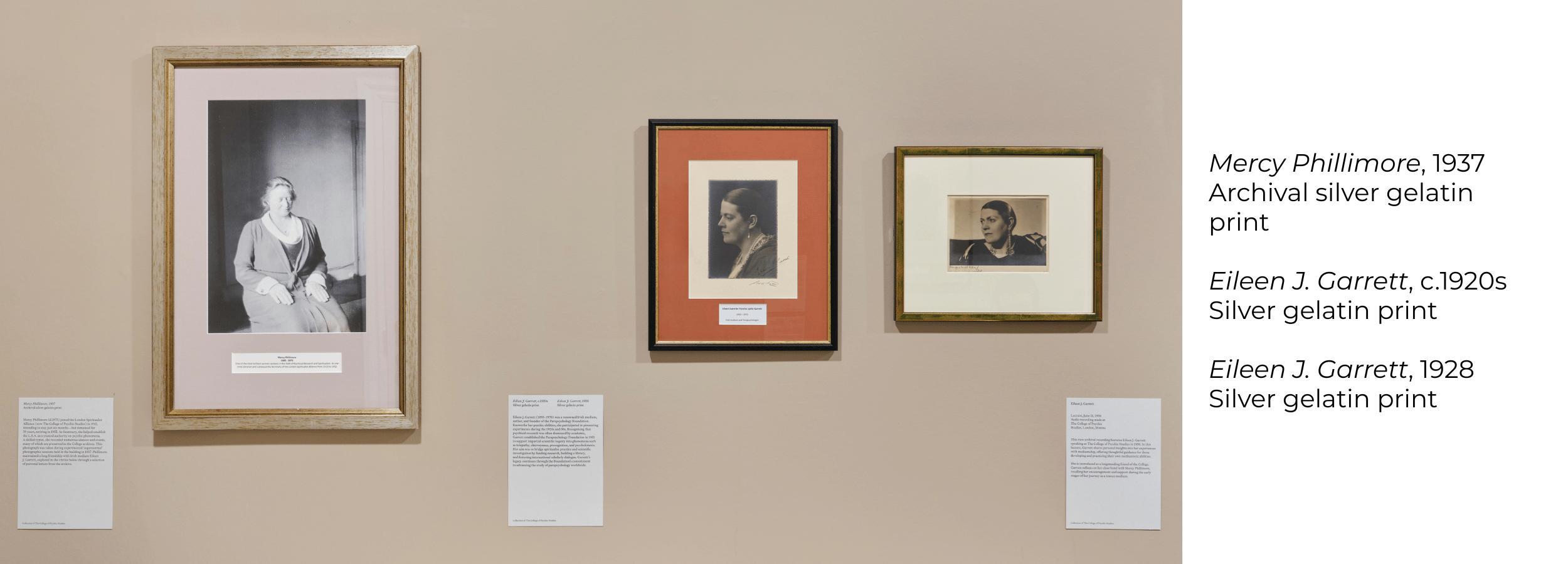
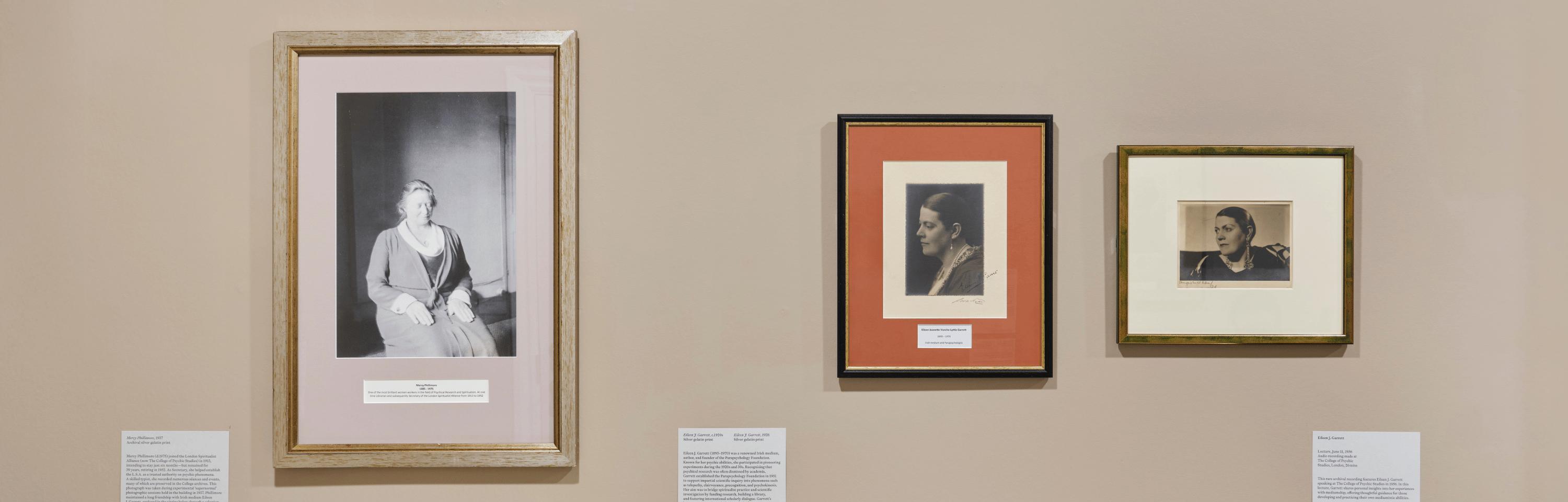
Mercy Phillimore (d.1975) joined the London Spiritualist Alliance (now The College of Psychic Studies) in 1913, intending to stay just six months—but remained for 39 years, retiring in 1952. As Secretary, she helped establish the L.S.A. as a trusted authority on psychic phenomena. A skilled typist, she recorded numerous séances and events, many of which are preserved in the College archives. This photograph was taken during experimental 'supernormal' photographic sessions held in the building in 1937. Phillimore maintained a long friendship with Irish medium Eileen J. Garrett, explored in the vitrine below through a selection of personal letters from the archive.
Eileen J. Garrett (1893–1970) was a renowned Irish medium, author, and founder of the Parapsychology Foundation. Known for her psychic abilities, she participated in pioneering experiments during the 1920s and 30s. Recognising that psychical research was often dismissed by academia, Garrett established the Parapsychology Foundation in 1951 to support impartial scientific inquiry into phenomena such as telepathy, clairvoyance, precognition, and psychokinesis. Her aim was to bridge spiritualist practice and scientific investigation by funding research, building a library, and fostering international scholarly dialogue. Garrett's legacy continues through the Foundation's commitment to advancing the study of parapsychology worldwide.
The display beneath the photographs featured letters reflecting the close, enduring friendship between Eileen J. Garrett and Mercy Phillimore, which began during their early work as colleagues at the London Spiritualist Alliance (L.S.A.). One letter documents James Hewat McKenzie's (1869–1929) agreement for Garrett to give consultations at the L.S.A. McKenzie was the founder of the British College of Psychic Science. Another, from the late 1920s, details a séance with Garrett as medium, with scientific notes by Phillimore recording room temperature, pulse, and spirit communications—including a ten-minute message from the spirit control 'John King' calling for 'more joviality in the circle.' A third, written in 1941, describes Garrett's humanitarian work in wartime France, her new publishing initiative, and her eventual safe passage to the U.S.
One letter expresses Eileen J. Garrett's distress at hearing of Mercy Phillimore's retirement and recommends Muriel Hankey (1895–1978) as her successor. Hankey began as secretary to James Hewat McKenzie at the British College of Psychic Science, taking on roles from organisational secretary to 'proxy sitter' in séances, before becoming an investigator in her own right. She and Garrett shared a long friendship. Hankey later served as Principal (1952–60) of The College of Psychic Studies at Queensberry Place. Garrett, one of McKenzie's students, maintained a close attachment to him and his training throughout her life.
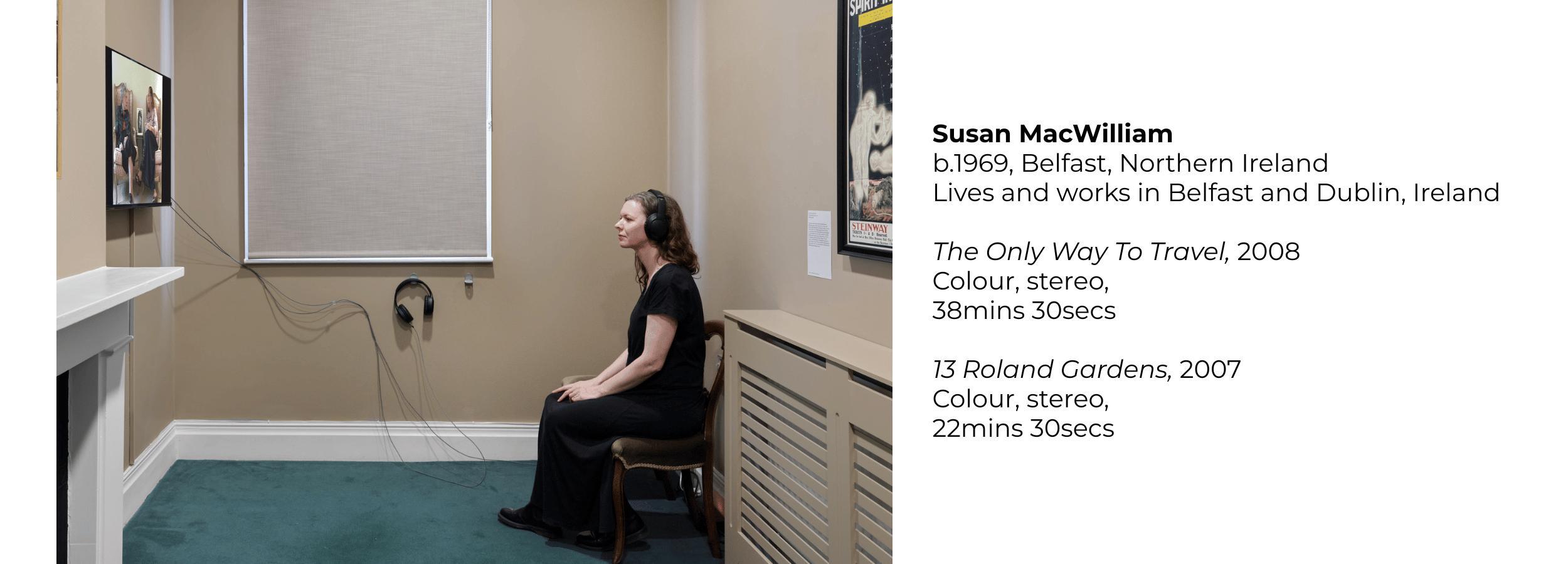
Susan MacWilliam's work investigates overlooked histories, perceptual phenomena, and the world of the paranormal. Working with video, photography, and installation, she often collaborates with parapsychologists and psychical research archives. These two video works reflect her long-standing engagement with the family of Irish trance medium Eileen J. Garrett. The Only Way to Travel focuses on Garrett's first journey to New York in 1931, invited by the American Society for Psychical Research, evoking the glamour and optimism of the era. In 13 Roland Gardens, Garrett's daughter, Eileen Coly, recalls her mother's famous 'R101 Airship Séance' and their time at the London home of Harry Price's Laboratory of Psychical Research.
The Theory & Practice of Spirit Intercourse poster below advertises four lectures by James Hewat McKenzie, author of Spirit Intercourse: Its Theory and Practice (1917) and founder of the British College of Psychic Science (1920–47). Created during the First World War, the image shows a fallen soldier guided from the battlefield by a spirit. McKenzie's book aimed to establish a scientific basis for spirit communication. Medium Eileen J. Garrett, who began her career at the British College of Psychic Science, credited McKenzie with shaping her approach to psychic work, writing: 'Whatever integrity and seriousness I have… I feel I owe to the untiring patience and faith in this unflinching and courageous man.
Geraldine Cummins
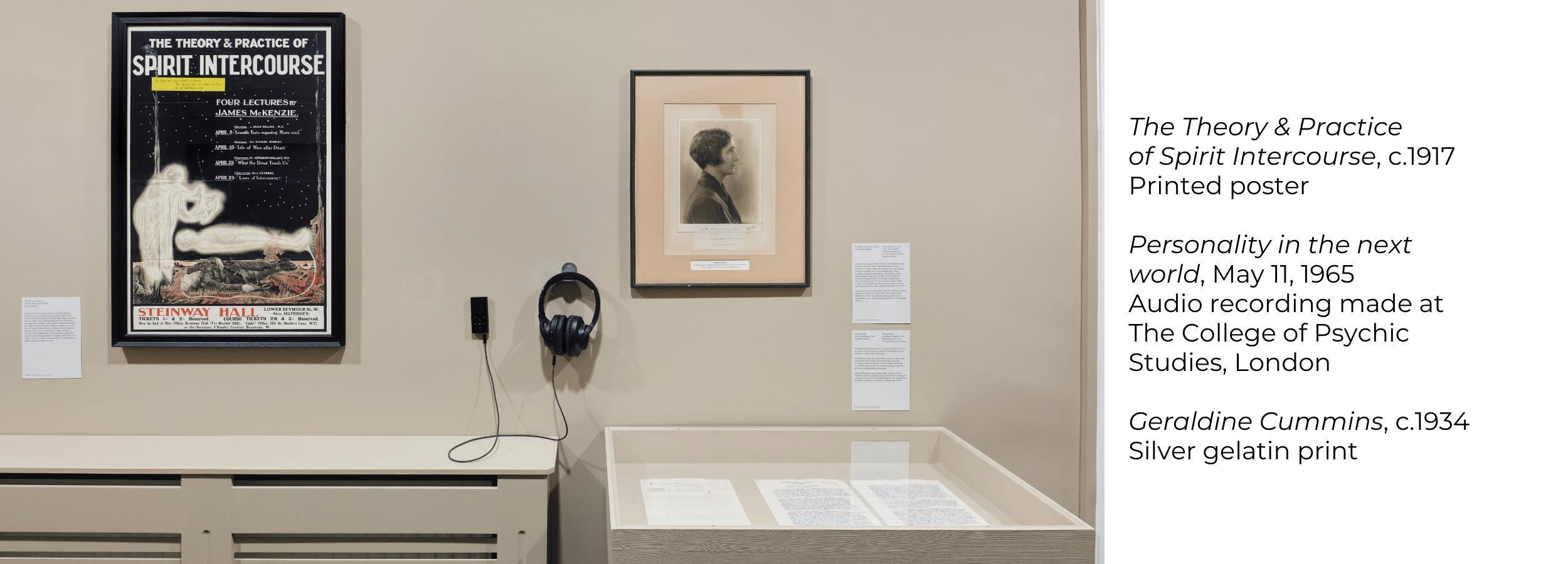
Geraldine Cummins (1890–1969) was an Irish playwright, novelist, and spiritualist medium best known for her automatic writings, which she referred to as 'transmitted writing'. Guided by her spirit communicator, Astor, Cummins claimed to channel texts from historical and spiritual figures. Her most notable works include The Scripts of Cleophas (1928), which offers insights into early Christianity, and The Road to Immortality (1932), a vision of the afterlife attributed to the spirit of eminent psychologist and psychical researcher Frederic W. H. Myers. Cummins was closely associated with The College of Psychic Studies, which preserves an archive of her papers and publications. This rare audio recording appears to be a channelled lecture, possibly featuring the voice or teachings of Myers.
During the Second World War, Geraldine Cummins worked secretly as a British agent in Ireland, identifying pro-Nazi factions to support the Allied cause. Cummins privately documented this work in a manuscript deposited at The College of Psychic Studies, marked to remain sealed for ten years after her death. Operating as a British agent in neutral Ireland was highly dangerous, given the complex political landscape. Upon reading the manuscript, College secretary Mercy Phillimore praised Cummins' 'physical and moral courage of a degree possessed by few,' highlighting her rare combination of psychic sensitivity, intelligence, and strength of will.
All photos: Eva Herzog. Artworks: Courtesy the artists, private collections and the collection of The College of Psychic Studies.
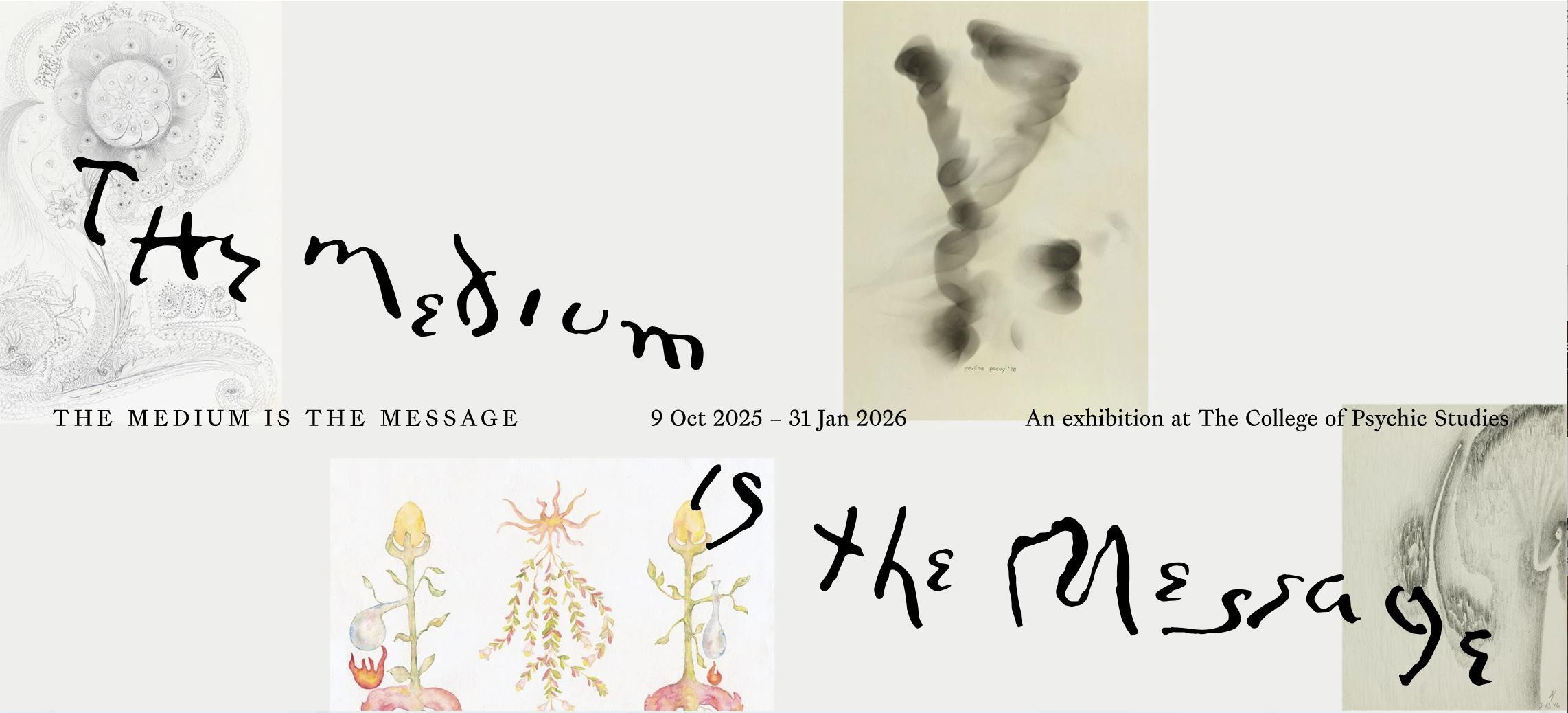
The Medium is the Message, 9 October 2025 –31st January 2026, was a major exhibition that explores the rich and complex relationship between artistic practice and mediumship.
Marking the centenary of The College of Psychic Studies' move to its historic home at 16 Queensberry Place in 1925, the exhibition spanned four floors and featured over 100 artworks alongside rare archival materials. It brought together more than 30 artists from the mid-19th century to the present day, examining how artists have visualised supernatural connection and imagined radical futures shaped by the ghostly and the unseen.
The Medium is the Message considered the artist as a channel between worlds – as a receiver of visions, energies and ideas. It highlighted the enduring role of mediumship within the College's history, with particular focus on the vital contributions of women – as artists, mediums, and feminist visionaries.
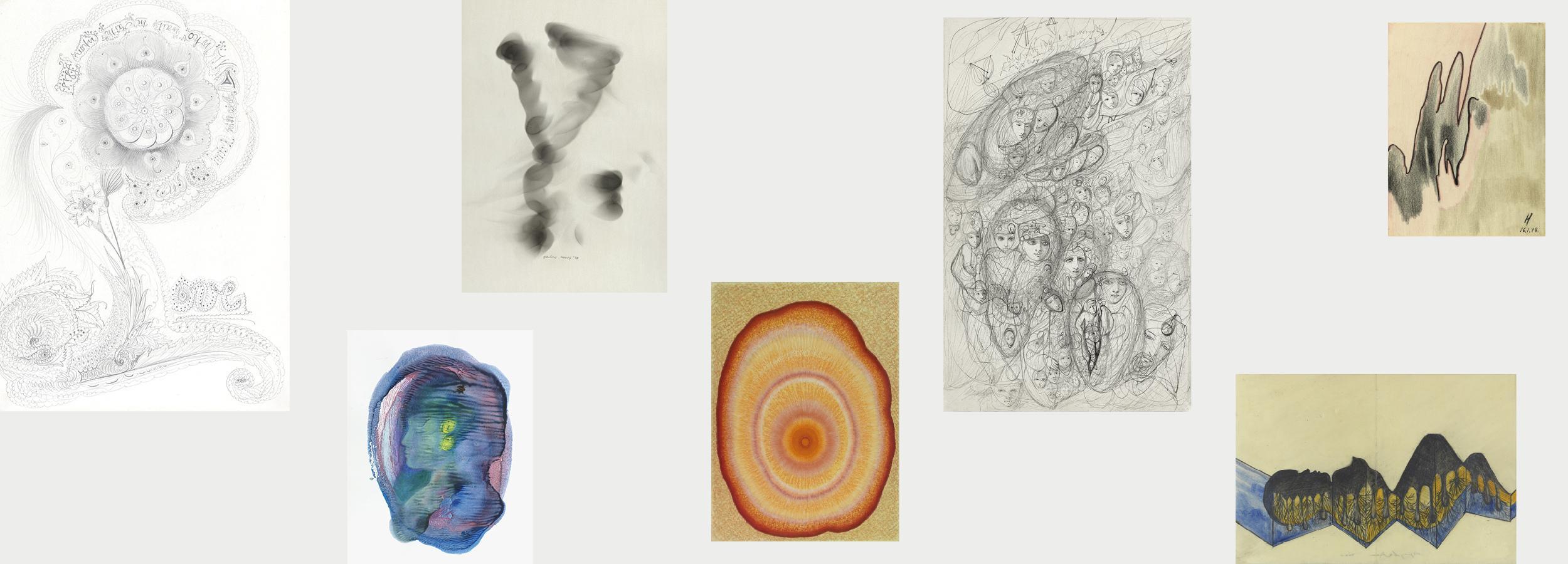
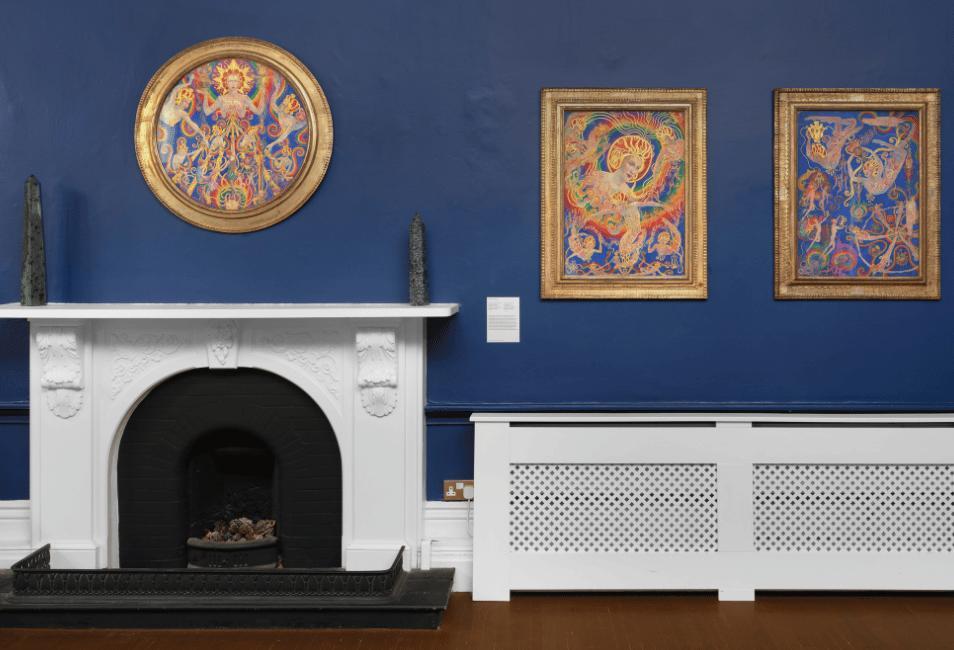
The exhibition included newly acquired works by Ithell Colquhoun, Aleksandra Ionowa, Sidney Manley, Ethel Le Rossignol, Anna Mary Howitt Watts and others alongside the first UK presentation of American visionary artist Paulina Peavy. These are shown in dialogue with works by contemporary artists including Sandra Vásquez de la Horra, Chantal Powell and Samir Mahmood, engaging with themes of spirit communication, ancestral memory, and the energetic connection between the body, Earth, and unseen realms.
Participating artists:
Mary Bligh Bond, Ann Churchill, Ithell Colquhoun, Joseph Crépin, Daniel, Dronma, Nicole Frobusch, Madge Gill, Anna Hackel, Stanislav Holas, Alme Hordijk, Frederick Hudson, Aleksandra Ionowa, Louise Janin, Freda Köhler, Augustin Lesage, Susan MacWilliam, Cara Macwilliam, Samir Mahmood, Sidney Manley, Margot, Cecilie Marková, Allen Moore o2o, Alice Essington Nelson, Heinrich Nüsslein, Paulina Peavy, František Jaroslav Pecka, Alice Pery, PIC, Chantal Powell, Victoria Rance, Arild Rosenkrantz, Ethel Le Rossignol, Victorien Sardou, Austin Osman Spare, Sarah Sparkes, Shannon Taggart, Mimei Thompson, Sandra Vásquez de la Horra, Anna Mary Howitt Watts, Ethel Annie Weir, Ariela Widzer, among others.
The Medium is the Message was curated by Jacqui McIntosh, Curator & Archivist at The College of Psychic Studies.
Join our newsletter to keep in touch with The College of Psychic Studies.