Writers talk about characters who seem to make their own choices, children speak of their 'imaginary' friends, and many of us know places where the atmosphere feels charged after something has happened there. Magical traditions have a name for presences like these: thoughtforms. A thoughtform is a being or presence brought into existence through imagination, intention, emotion and focused attention. It is one of magic's most compelling ideas; that a being can be deliberately created through the mind and sustained through its relationship with its creator.
Thoughts are things: the Theosophical vision
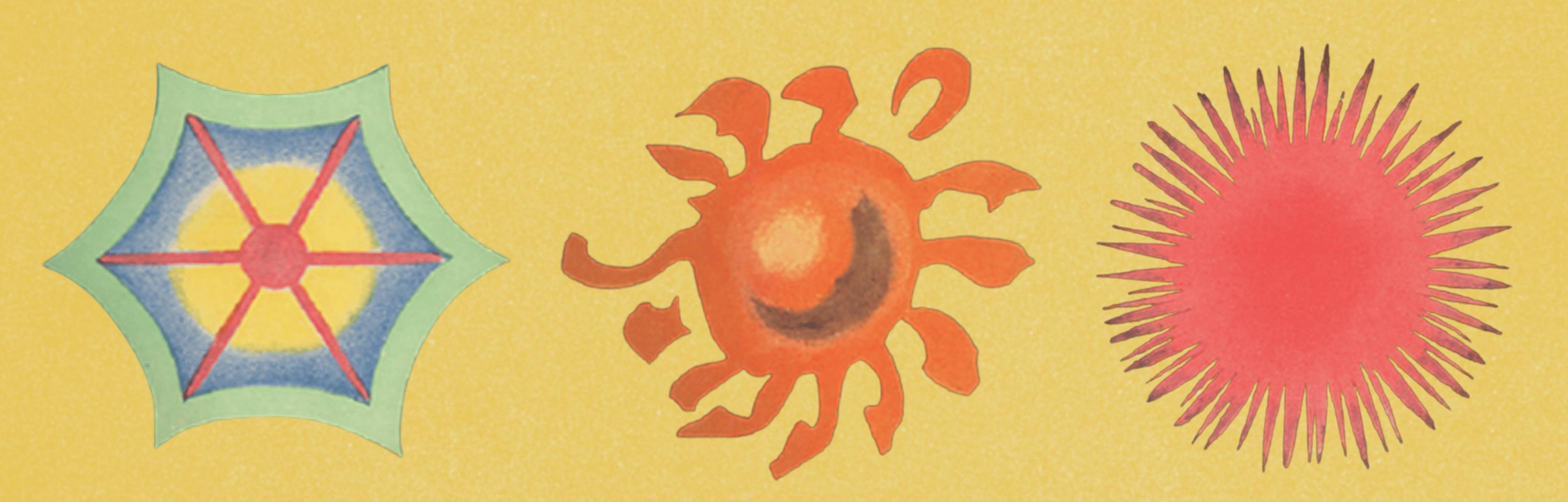
The idea of thoughtforms owes much of its modern popularity to Theosophy. In September 1896, Annie Besant reported in the Theosophical journal Lucifer that two clairvoyant Theosophists, whose names were not given, had begun observing the substance of thought. Their research grew into the book Thought-Forms, which is available at The College of Psychic Studies. In its foreword, Besant explains that the forms were observed by Leadbeater, by herself or by both of them together, and were drawn and painted by three friends: John Varley, Mr Prince and Miss Macfarlane. Varley was the grandson of the painter John Varley.
Besant and Leadbeater set out a simple system for how thoughts take shape. Starting from the premise that thoughts are things, they proposed three principles:
1. the quality of a thought determines its colour
2. its nature determines its form, and
3. its definiteness determines how clear its outline is.
A colour key in the book gives each shade a meaning, with light blue for high spirituality and black for malice.
The illustrations are striking. Some plates show forms of devotion and three different kinds of love, while others show three types of anger. One plate, The Gamblers, shows forms the authors said they observed at the great gambling house in Monte Carlo, representing the feelings of a winning and a losing gambler. Another shows the thought-form of an actor waiting to go on stage. You are welcome to visit The College of Psychic Studies and browse the book in the Reading Room, or buy it in the shop.
Painting the invisible
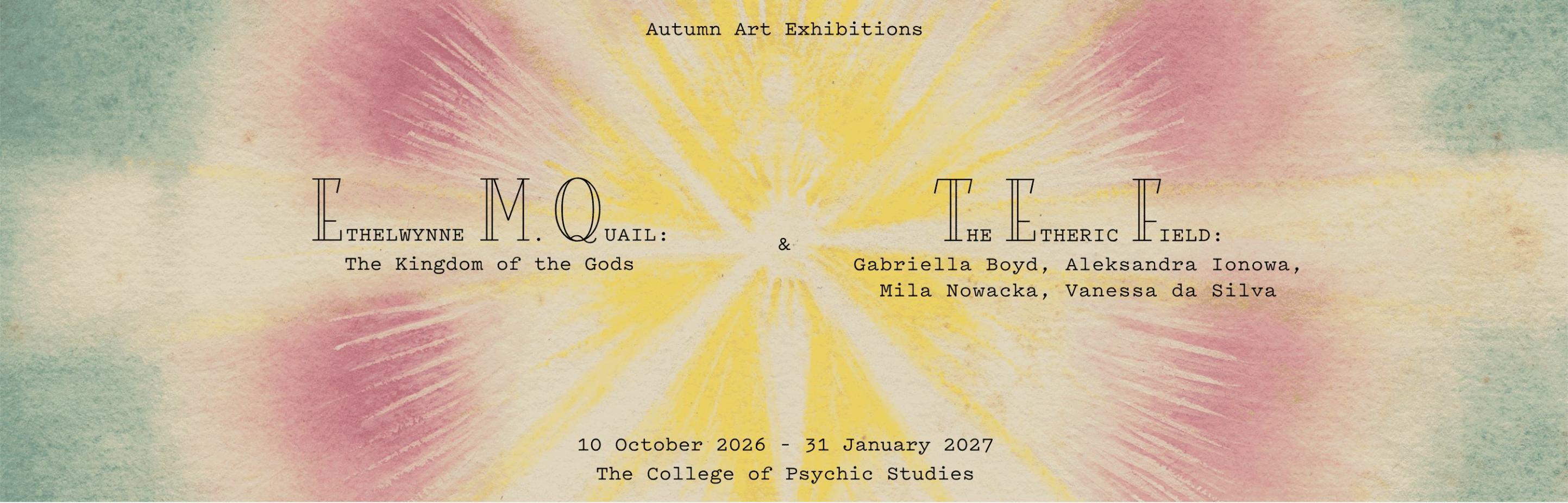
Theosophy's challenge of painting what only a clairvoyant could see did not end with Thought-Forms. In the 1930s, the self-taught South African artist Ethelwynne M. Quail (1903–1947) entered a similar partnership with the clairvoyant and writer Geoffrey Hodson. Hodson described what he perceived, and Quail translated it into watercolour and gouache, much as Varley, Prince and Macfarlane had done for Besant and Leadbeater. Most of her subjects were devas, which Theosophy understood as intelligences of nature rather than creations of the human mind. Yet one of her paintings is titled A thought form of 'Our Lady The Star of the Sea' (The World Mother), which shows how closely the two ideas sat together. Her paintings were reproduced in Hodson's The Kingdom of the Gods (1952), and the originals are now on public display for the first time in our free exhibition, Ethelwynne M. Quail: The Kingdom of the Gods, at The College of Psychic Studies until 31st January 2027. Hodson's book, The Kingdom of the Gods, is also available to read in the Reading Room and purchase in the shop.
Thoughtforms as muse
Thought-Forms also travelled far beyond Theosophical circles. Artists including Wassily Kandinsky, Piet Mondrian and Luigi Russolo drew on Theosophy as a philosophical basis for their work. Kandinsky bought a copy of Thought-Forms in 1908 and joined the Theosophical Society the following year. The art historian Sixten Ringbom argued that the book influenced Kandinsky directly, although some scholars consider that claim uncertain.
The tulpa of Alexandra David-Néel
The explorer Alexandra David-Néel (1868-1969) said she had observed Buddhist practices for creating tulpas in Tibet, describing them as magical formations produced by intense concentration of thought. In her book, With Mystics and Magicians in Tibet (published in French in 1929, in English in 1931), she claimed to have created a tulpa herself, in the image of a jolly monk resembling Friar Tuck. According to her account, it later developed a life of its own and had to be destroyed. She also described the figure being seen by other people, who mistook it for a real person.
Dion Fortune and the accidental wolf
Dion Fortune was born Violet Mary Firth in Llandudno, Wales, on 6 December 1890, and became one of the leading British occultists of her time. In the preface to Psychic Self-Defence (1930), she explains that a psychic attack, which left her health shattered for a long period, first turned her towards psychology and then towards occultism.
In the same book, she distinguishes artificial elementals from ordinary thought-forms. Once created by a magician, an artificial elemental has an independent life of its own, but its nature is still shaped by its creator's idea of it. Like an electric battery, its life slowly leaks away and it will fade unless it is recharged. She adds that "guardian angels" can be formed in the same way.
One of her most famous stories is about a thoughtform she made by accident. Badly hurt by someone she had helped, she lay on her bed one afternoon brooding on revenge. As she drifted towards sleep, she thought of Fenris, the monstrous wolf of Norse myth, felt a drawing-out sensation from her solar plexus, and a large wolf materialised beside her on the bed. When she ordered it off the bed, it changed from a wolf to a dog and left the room. The next morning, another member of her household reported dreaming of wolves and seeing an animal's eyes shining in the dark.
Her teacher told her she had made the creature from her own substance through vengeful thoughts, and that she must reabsorb it and give up her wish to settle the score. She did so at dusk, drawing the life back along a cord of ectoplasm until the form faded into grey mist and disappeared.
Fortune offered a way of holding spiritual and psychological explanations together. Writing about patients who believed they were tormented by invisible beings, she argued that the psychic and the psychologist could both be right: what the psychic perceives is the patient's dissociated complex, projected outwards as a thought-form.
The Philip experiment
Psychical researchers have tested the idea too. In 1973, eight members of the Toronto Society for Psychical Research set out to investigate the psychokinetic phenomena reported in séances by inventing a "discarnate spirit", complete with an identity, personality and memories. The group had no doubt that Philip's personality was a composite of their own, and Alan Gauld of the Society for Psychical Research in England analysed recordings of Philip's raps, finding that they sounded different from raps made normally. Iris Owen and Margaret Sparrow described the experiment in detail in their 1976 book Conjuring Up Philip.
Spirit, psyche or something in between?
So what is a thoughtform, really? An independent entity, a psychological construct, or a product of the creative imagination? From Tibetan tulpas and spirit familiars, through Theosophy and ceremonial magic, to the modern chaos magic idea of the servitor, the concept has been read in all these ways, and there is room for all of these readings to coexist.
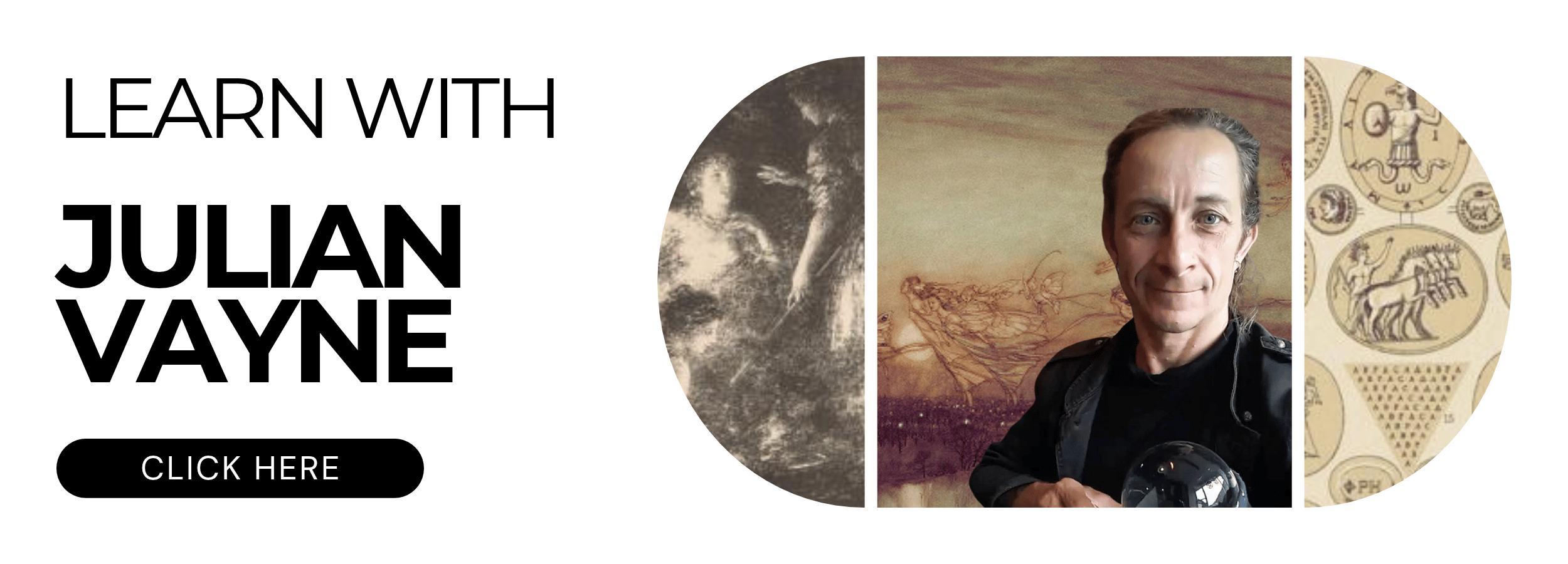
Explore thoughtforms with Julian Vayne
If you'd like to explore this fascinating subject in depth, join occultist and author Julian Vayne for Thoughtforms: Creating Magical Beings. You'll move from history and theory into direct experimentation, culminating in the creation of your own thoughtform.
References
- Besant, A. and Leadbeater, C.W. Thought-Forms. London: Theosophical Publishing House. First edition dated 1901 in later printings, but see Introvigne (2025) on a 1905 first edition. Available in The College of Psychic Studies shop.
- David-Néel, A. (1929) Mystiques et magiciens du Thibet. Paris: Plon. English translation: With Mystics and Magicians in Tibet (1931), London: The Bodley Head; later published as Magic and Mystery in Tibet.
- Fortune, D. (1930) Psychic Self-Defence. Modern edition: Psychic Self-Defense, Weiser Classics, Red Wheel Weiser, 2020.
- Owen, I. and Sparrow, M. (1976) Conjuring Up Philip: An Adventure in Psychokinesis. Ontario: Fitzhenry & Whiteside; New York: Harper & Row.
- Introvigne, M. "Theosophy and the Birth of Abstract Art." Bitter Winter (series). bitterwinter.org
- Society for Psychical Research. "Philip Psychokinesis Experiments." Psi Encyclopedia. psi-encyclopedia.spr.ac.uk
Visit the free autumn exhibitions:
Join our newsletter for updates on our magic courses.