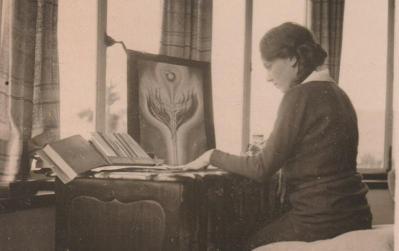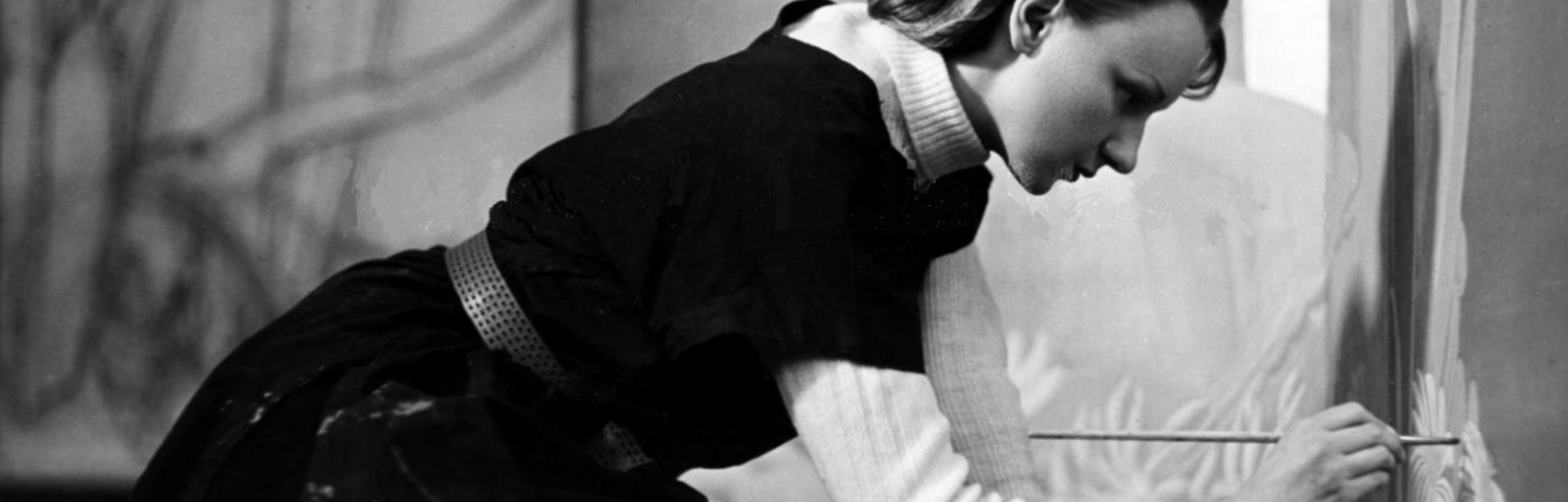
Artist Ithell Colquhoun (1906-1988) believed that the truest images were revealed rather than planned. She developed and refined a set of Surrealist 'automatic' techniques designed to bypass conscious control altogether, allowing form and meaning to surface from somewhere deeper. There are three methods in particular that you can easily try yourself: fumage, parsemage and decalcomania.
Fumage: Reading the smoke
Fumage is the most elemental of Ithell Colquhoun's automatic techniques. A sheet of paper is passed above a lit candle, and the smoke leaves behind delicate, unplanned trails of soot across its surface (McIntosh, 2025). There is no way to fully predict or control where the smoke will gather or how it will curl, which is precisely the point: the resulting marks arrive without deliberate authorship, ready to be read rather than composed from scratch, and we discover figures and landscapes already half-formed within the soot (Tate, n.d.). To try this at home, all you need is a candle, a sheet of paper and a steady hand – hold the paper a little above the flame, moving it slowly so the smoke gathers rather than scorches, then sit with what emerges before deciding what it might mean.
Parsemage: Chance upon the water
Parsemage, a technique Colquhoun herself is credited with devising, works through water rather than fire. Powdered chalk or charcoal is scattered across the surface of water, then skimmed off using a stiff sheet of card or paper passed just beneath the surface (McIntosh, 2025). What lifts away carries with it a chance arrangement of dust – a pattern no hand could have planned – caught in a single fleeting gesture. Practice the technique for yourself with artist Chantal Powell in her workshop. At home, a shallow tray of water, a little chalk dust or ground pastel, and a piece of card is all it takes – the pattern reveals itself in a moment, and won't come again quite the same way twice.
Decalcomania: The mirrored stain
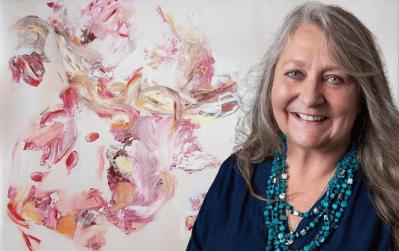
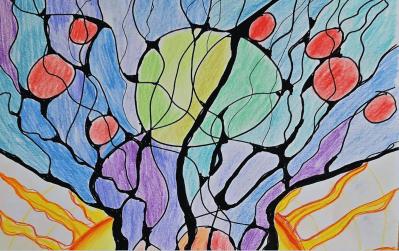
Decalcomania became perhaps Ithell Colquhoun's most enduring and prolific method. Paint or ink is applied to one surface, then a second surface is pressed against it and peeled away, revealing an abstract, often symmetrical impression – not unlike a Rorschach inkblot. Colquhoun used a particular variant of this technique, sometimes called stylomancy, in which paper is folded and unfolded rather than pressed against a separate sheet, producing a mirrored pattern from a single surface. From these accidental stains, she would draw out and clarify figures with pencil, ink or further paint, letting the chance form guide the finished composition (Victoria and Albert Museum, n.d.). This is perhaps the easiest of the three to try at home: a blob of paint on a folded sheet of paper, pressed and opened out, is often enough to conjure a face, a creature or a landscape you didn't consciously set out to make. Discover the technique at The College of Psychic Studies in artist Anji Main's workshop.
Automatism as divination
What unites all her automatic techniques is Colquhoun's underlying conviction that automatism and divination were close relations. In her 1949 essay The Mantic Stain, she chose her terminology with care: "mantic" derives from the Greek for prophecy, and she understood these chance-made images as a form of scrying, akin to reading patterns in a crystal or a bowl of water (Colquhoun, 1949). The stain, in her view, was not merely an artistic device but a genuine channel – a way of allowing something beyond ordinary consciousness to speak through the materials themselves (McIntosh, 2025).
Colquhoun brought her methods to a wider public in 1949, demonstrating fumage, parsemage and decalcomania live on the BBC's Eye of the Artist: Fantastic Art – the first public presentation of automatist techniques on British television (Tate, n.d.). It remains a rare, tangible record of an artist attempting to show, quite literally, how she let go of conscious control in order to find something true.
How automatic art supports psychic development
For students on the psychic development path, Ithell Colquhoun's techniques offer a practice beyond artistic curiosity. Mediumship and intuitive work both depend on the same basic skill: learning to quiet the rational, editing mind for long enough for something else to come through. Automatic art gives that skill a low-stakes, hands-on training ground.
When you hold a piece of paper over a candle flame or unfold a stain of paint, you have no choice but to release control of the outcome. There is nothing to plan and nothing to get "right" – the image is already made before your conscious mind has a chance to interfere. This is precisely the muscle that intuitive and mediumistic work asks you to build: the ability to notice an impression, a symbol, or a feeling arising from beyond deliberate thought, and to trust it enough to describe it before the rational mind steps in to edit or dismiss it.
Working with chance-made images also sharpens the skill of interpretation itself. Looking at a smoky trail or a folded stain and allowing a figure, a landscape, or a symbol to emerge is not so different from receiving an impression in a reading and learning to translate it into meaning. Both call on the same faculty: a willingness to see what's actually there, rather than what you expect to see.
Finally, there is something valuable in Colquhoun's own framing of these techniques as a form of scrying. She didn't consider automatism separate from her spiritual and occult practice. It was one continuous exploration of how consciousness can be opened to something beyond itself. For students developing their own psychic awareness, her methods are a reminder that the path to insight doesn't always run through concentration and effort. Sometimes, as Colquhoun understood so well, it runs through letting go.
This article is informed by 'The Energetic Line: The Drawings & Works on Paper of Ithell Colquhoun', an essay by Jacqui McIntosh, The College of Psychic Studies' curator.
References
Colquhoun, I. (1949) 'The Mantic Stain', Enquiry, 2(4).
McIntosh, J. (2025) 'The Energetic Line: The Drawings & Works on Paper of Ithell Colquhoun'. In Norris, Katy (ed.). Ithell Colquhoun: Between Worlds. London: Tate
Tate (n.d.) Ithell Colquhoun: Exhibition Guide. Available at Tate/Ithell Colquhoun (Accessed: 30 July 2026).
Victoria and Albert Museum (n.d.) Triton, watercolour, Ithell Colquhoun. Available at VAM/Triton by Ithell Colquhoun (Accessed: 30 July 2026).