In The Medium is the Message, the Earth is a Being room brings together artists who explore the Earth not simply as landscape or resource, but as a sentient, symbolic being—alive with energy, memory, and spiritual potential. Drawing on alchemical, esoteric, and mystical traditions, the works engage with a connection to the Earth and unseen realms through symbolic imagery, ritual, and embodied experience.
The starting point is a dream diary entry by British artist and occultist Ithell Colquhoun, in which she reflects on her animistic beliefs and the Earth's sacred centres—places of heightened perception and spiritual power. In dialogue with Colquhoun's work, contemporary artists Nicole Frobusch, Samir Mahmood, Chantal Powell and Sandra Vásquez de la Horra present the body as a conduit for unseen forces, emphasising the importance of cultivating a spiritual connection to the environment through reverence rather than extraction.
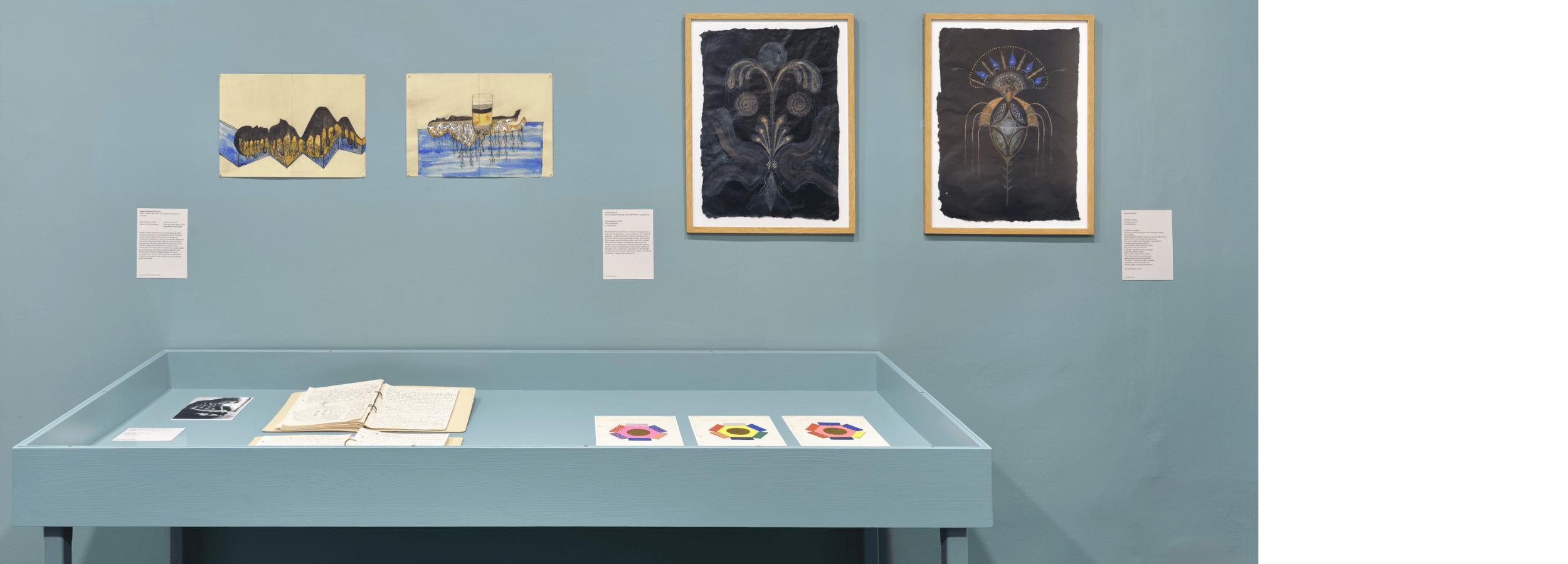
Sandra Vásquez de la Horra's wax-sealed drawings often emerge from dreams, creating imagined realms that blend ancient Chilean myths with spiritual knowledge and unconscious symbolism. In these two works, the silhouetted female form becomes Mother Earth, her roots extending through layers of strata, echoing the mountainous terrain of Chile. Vásquez de la Horra's works convey a deep connection to the Earth and unseen forces, weaving together personal memory, mythology, and philosophical inquiry. Raised under Pinochet's regime and later relocating to Germany, her practice reflects a desire to understand her place in the world—what it means to exist, to belong, and to remember.
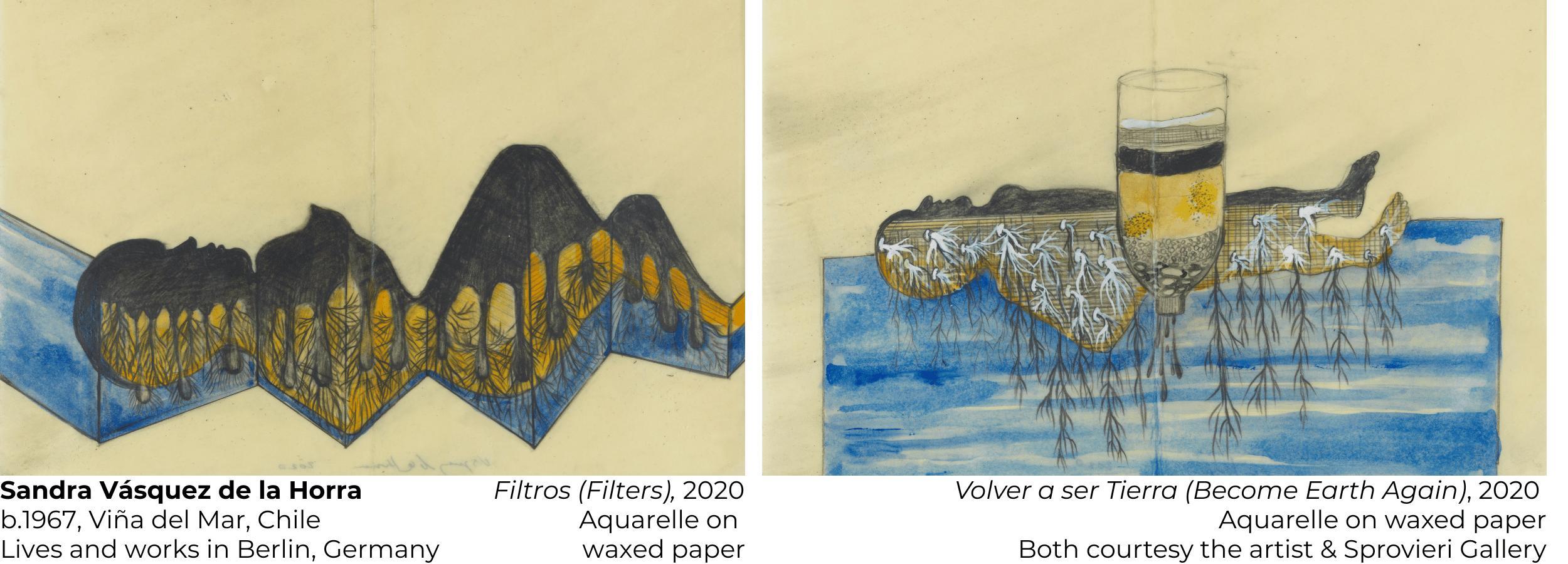
Nicole Frobusch's work draws on ancient wisdom, geometry, and ritual, emerging from visions and dreams. Her handmade pigments—crafted from plants, minerals, and sacred sites— carry the Earth's essence and energies. In this work, natural forms suggest growth, fertility, and the cycles of the female body and moon. Shapes echo fallopian tubes, roots, and energetic flow, creating connections between the body and unseen realms. 'Communication with the spirit world is not through words or ritual alone,' says Frobusch, 'but through symbolic growth, where the veil between worlds is a blooming membrane—organic, alive, and ancient.'
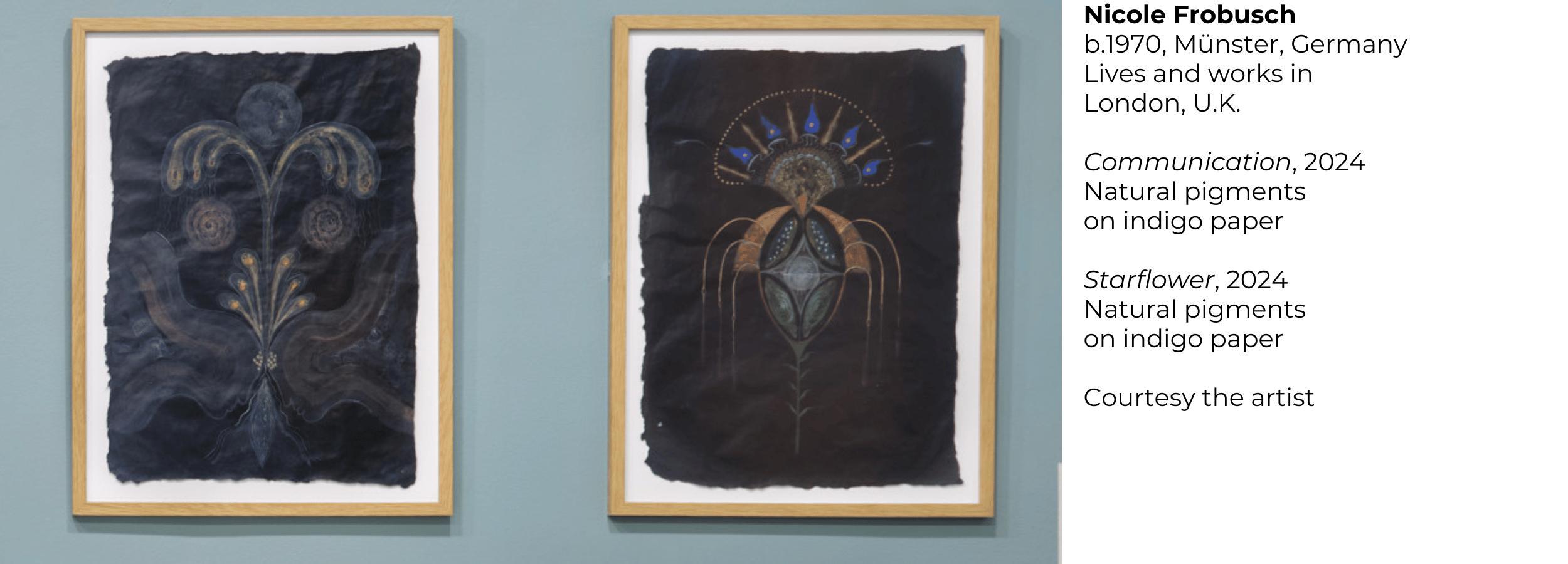
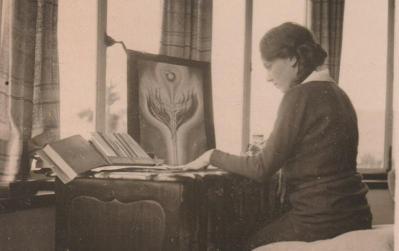
Ithell Colquhoun kept detailed dream diaries throughout her life, using them as raw material for her novels, short stories, poems, and artworks, and as an important part of her magical studies. In one entry, Colquhoun formulates her animistic thinking, writing in January 1968: 'Realised that the Earth is a being and that certain places on its surface and leading to its interior are conducive to different kinds of esoteric perception.' Colquhoun termed these places 'Fountains out of Hecate'—a network of power-centres that appear over the Earth's surface that she related to chakras within the body. Other displayed pages show drawings encountered in dreams made on awakening.
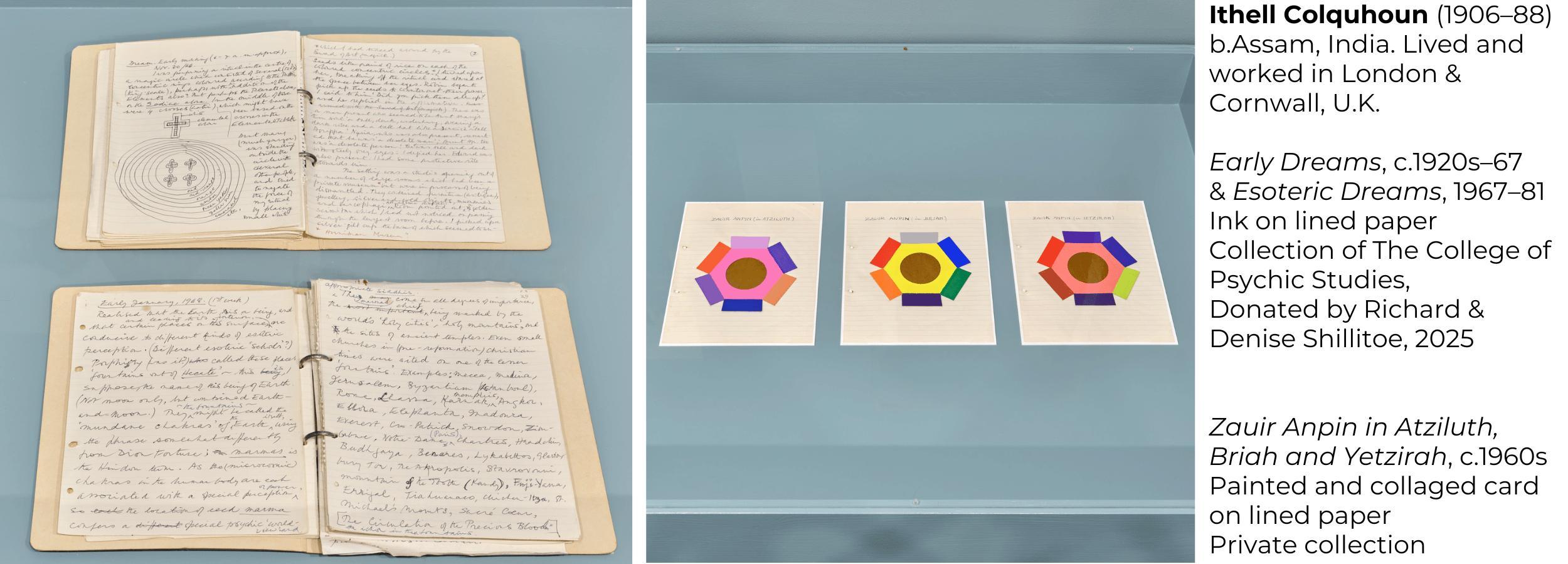
Ithell Colquhoun's three diagrammatic works, above right, explore magical colour theory through Kabbalistic cosmology, illustrating the colour attributions of the Zauir Anpin (Microprosopus) across three spiritual worlds beyond physical existence. Colquhoun's long-standing interest in the Kabbalah was shaped by her involvement with esoteric groups such as The Quest Society, Dion Fortune's Society of the Inner Light, and her lifelong fascination with the Hermetic Order of the Golden Dawn. Her deep engagement with occult study informed her artistic practice, often expressed through diagrammatic compositions, using drawing, gouache, and collage to translate complex ideas into visual form.
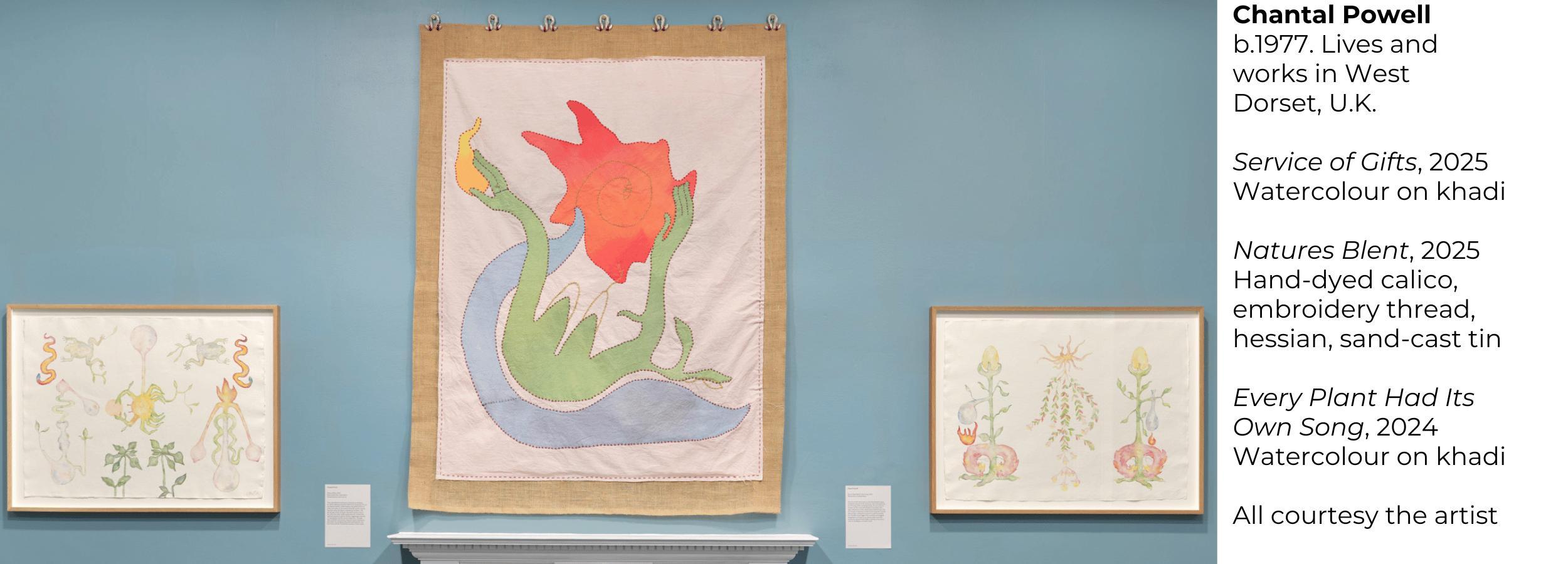
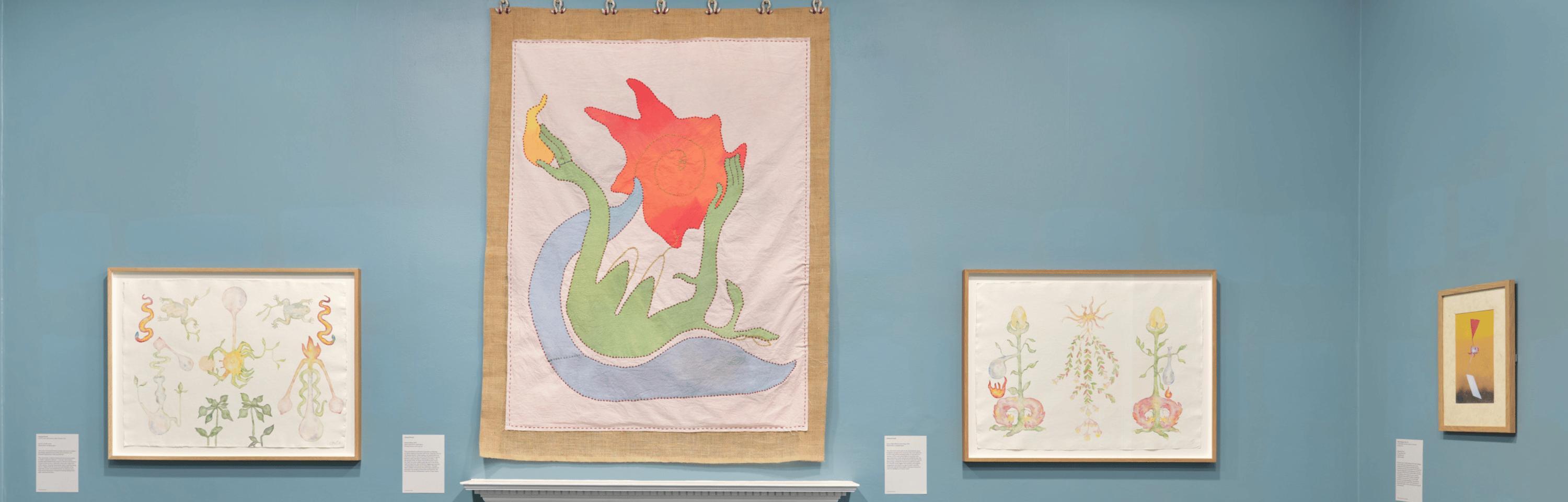
The works of Chantal Powell are deeply informed by Jungian psychology, alchemical and archetypal symbolism, and personal explorations of the unconscious. Service of Gifts, above left, combines alchemical and natural symbols to explore vegetative alchemy—a concept where plants, animals, and symbolic forms coexist as sentient and interconnected. At the centre, a crab holds a lunar disc, inspired by a 15th century Armenian manuscript, with a vessel sprouting from it. Aligned with the moon, the crab embodies cycles of growth, retreat, and transformation. Its sideways movement mirrors the moon's waxing and waning, linking water, night, and emotional flux.
This embroidered textile Natures Blent (above centre) responds to a drawing by Ithell Colquhoun from her 1941 series 'Diagrams of Love' (on display nearby, see below right), which explores the elemental forces of fire and water. At the centre of Powell's work is a green, feminine, plant-like figure symbolising Veriditas—the life-giving vitality of nature. One hand reaches toward fire, while the other cradles a glowing seed. A blue form, representing water, pierces the fire, suggesting a moment of impregnation and the union of opposites. Through these symbolic interactions, the piece enacts alchemical principles: the merging of masculine and feminine, fire and water, and the transformative power of their union.
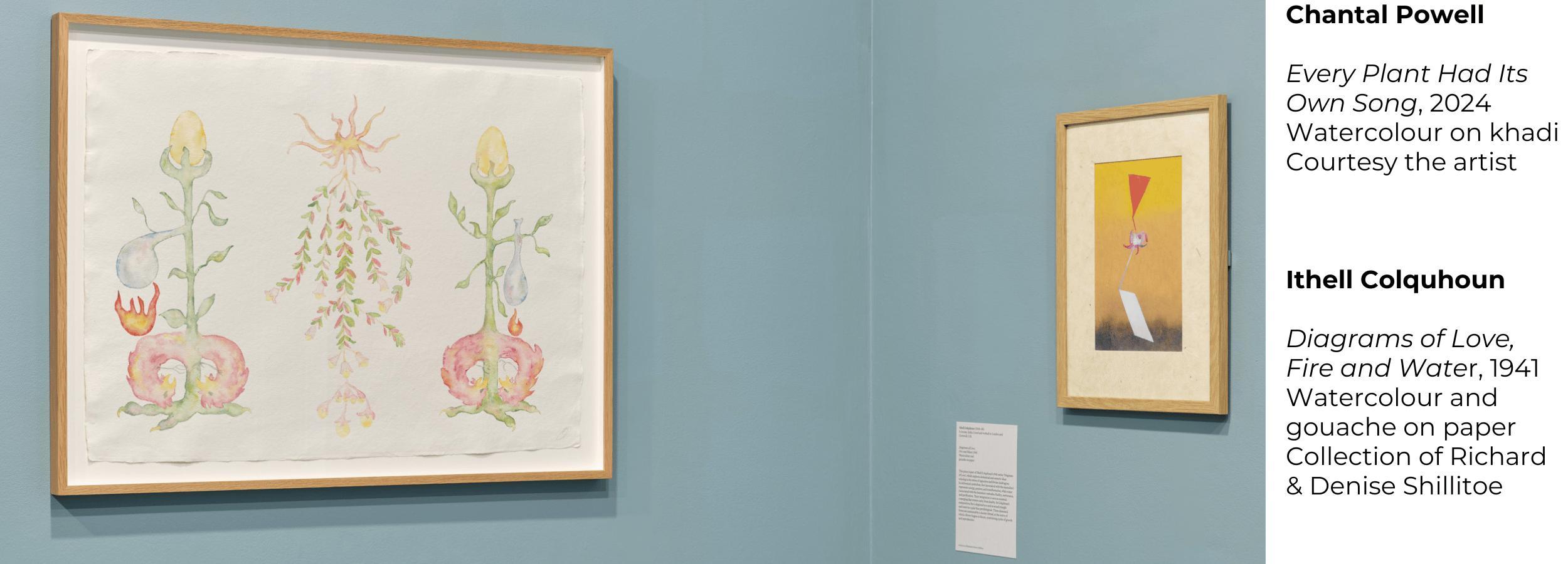
The title of Chantal Powell's watercolour, above left, refers to the belief, held by many Indigenous peoples of the Americas, that every plant has its own song, and by listening closely, we can access its wisdom. In this work, hybrid plants intertwine with eggs, alchemical vessels, and animal and bird forms. The central plant references an illustration from the Voynich Manuscript, evoking the mysterious qualities of plant life. Powell's works suggest that symbolic and imaginal engagement with plants can open portals to psychic, emotional, and spiritual insight, creating an encounter with the intelligence of matter itself.
The piece, above right, is part of Ithell Colquhoun's 1941 series 'Diagrams of Love', which explores alchemical and esoteric ideas relating to the union of opposites and Divine Androgyne. In alchemical symbolism, fire (associated with the masculine) represents energy, passion, and transformation, while water (associated with the feminine) embodies fluidity, nurturance, and purification. Their integration is seen as essential: a merging that creates unity from duality. In Colquhoun's composition, fire is depicted as a red inverted triangle and water as a pale blue parallelogram. These elemental forms are connected by a slender thread, at the centre of which a flower begins to bloom, symbolising cycles of growth and reproduction.
All photos: Eva Herzog. Artworks courtesy of the artists & collection of The College of Psychic Studies.
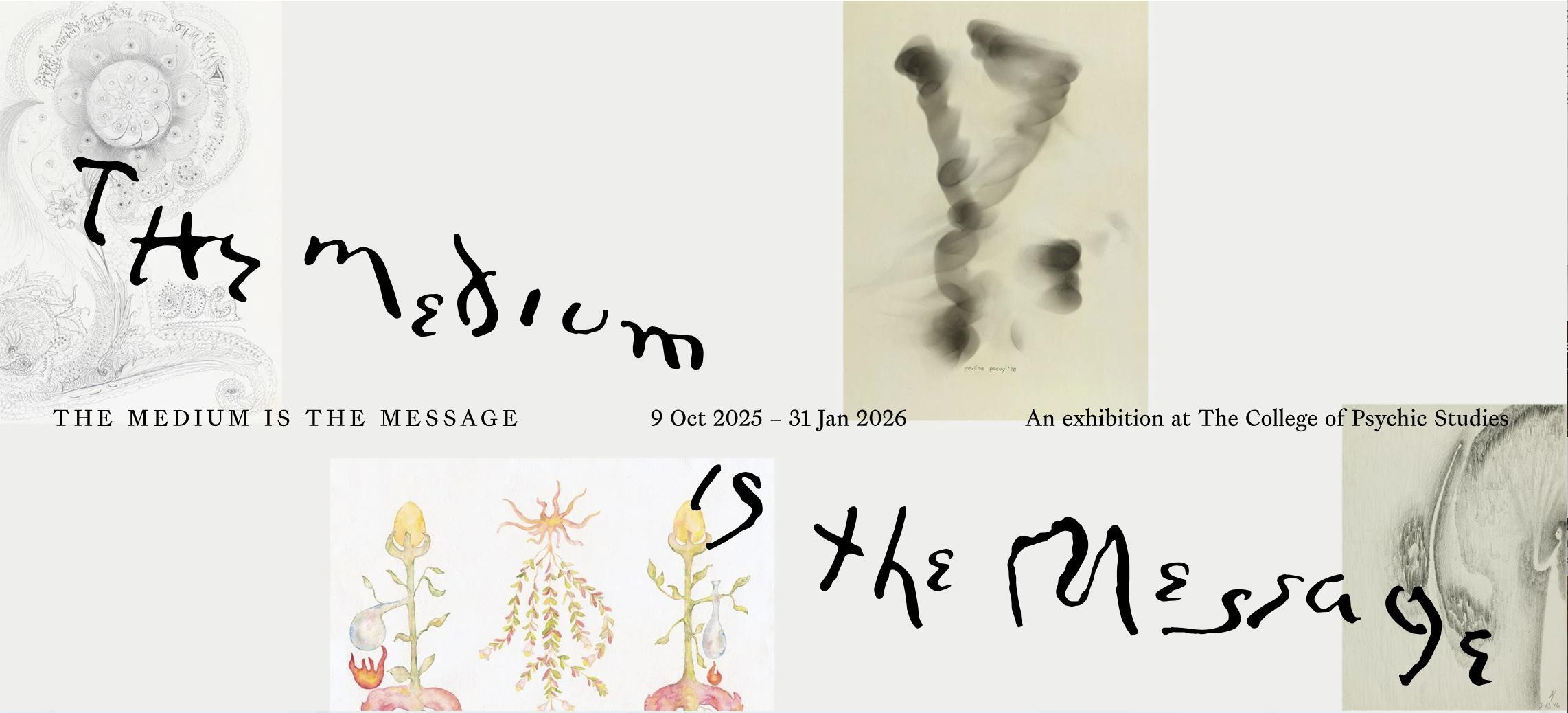
The Medium is the Message, 9 October 2025 –31st January 2026, was a major exhibition that explored the rich and complex relationship between artistic practice and mediumship.
Marking the centenary of The College of Psychic Studies' move to its historic home at 16 Queensberry Place in 1925, the exhibition spanned four floors and featured over 100 artworks alongside rare archival materials. It brought together more than 30 artists from the mid-19th century to the present day, examining how artists have visualised supernatural connection and imagined radical futures shaped by the ghostly and the unseen.
The Medium is the Message considered the artist as a channel between worlds – as a receiver of visions, energies and ideas. It highlighted the enduring role of mediumship within the College's history, with particular focus on the vital contributions of women – as artists, mediums, and feminist visionaries.
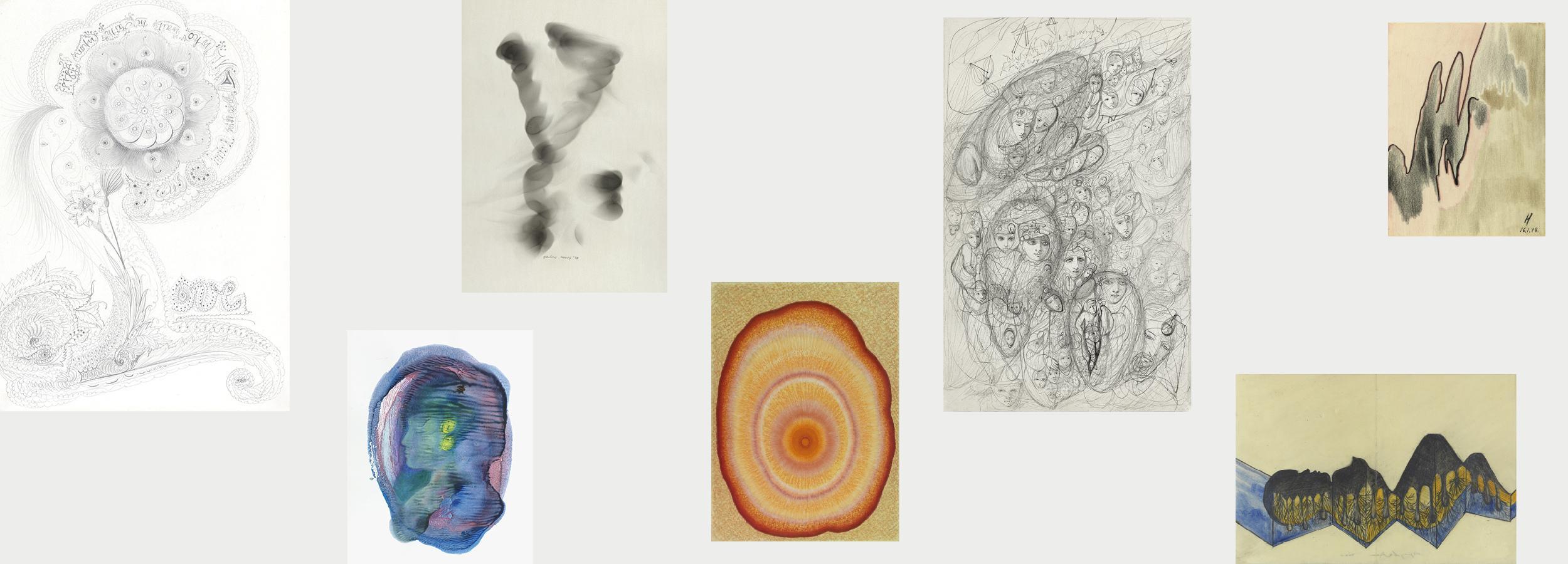
The exhibition included newly acquired works by Ithell Colquhoun, Aleksandra Ionowa, Sidney Manley, Ethel Le Rossignol, Anna Mary Howitt Watts and others alongside the first UK presentation of American visionary artist Paulina Peavy. These are shown in dialogue with works by contemporary artists including Sandra Vásquez de la Horra, Chantal Powell and Samir Mahmood, engaging with themes of spirit communication, ancestral memory, and the energetic connection between the body, Earth, and unseen realms.
Participating artists:
Mary Bligh Bond, Ann Churchill, Ithell Colquhoun, Joseph Crépin, Daniel, Dronma, Nicole Frobusch, Madge Gill, Anna Hackel, Stanislav Holas, Alme Hordijk, Frederick Hudson, Aleksandra Ionowa, Louise Janin, Freda Köhler, Augustin Lesage, Susan MacWilliam, Cara Macwilliam, Samir Mahmood, Sidney Manley, Margot, Cecilie Marková, Allen Moore o2o, Alice Essington Nelson, Heinrich Nüsslein, Paulina Peavy, František Jaroslav Pecka, Alice Pery, PIC, Chantal Powell, Victoria Rance, Arild Rosenkrantz, Ethel Le Rossignol, Victorien Sardou, Austin Osman Spare, Sarah Sparkes, Shannon Taggart, Mimei Thompson, Sandra Vásquez de la Horra, Anna Mary Howitt Watts, Ethel Annie Weir, Ariela Widzer, among others.
The Medium is the Message was curated by Jacqui McIntosh, Curator & Archivist at The College of Psychic Studies.
Join our newsletter to keep in touch with The College of Psychic Studies.