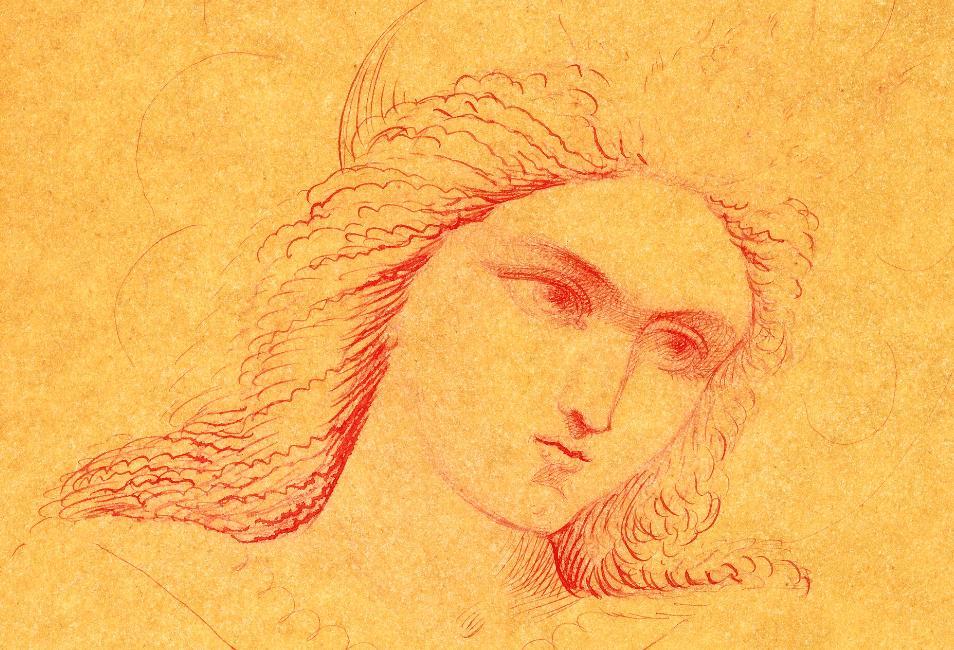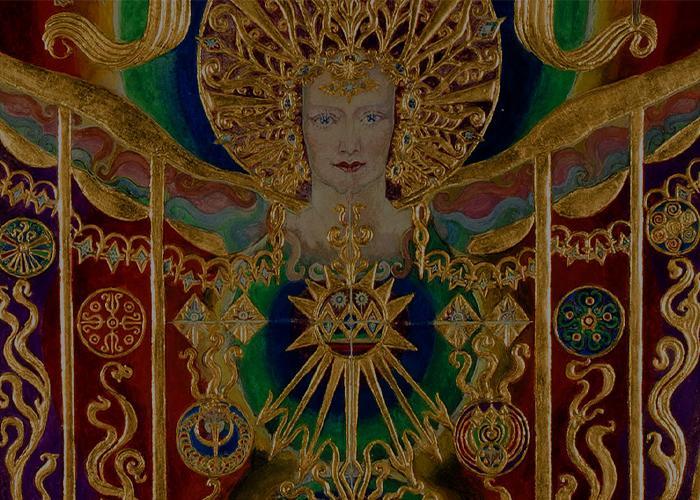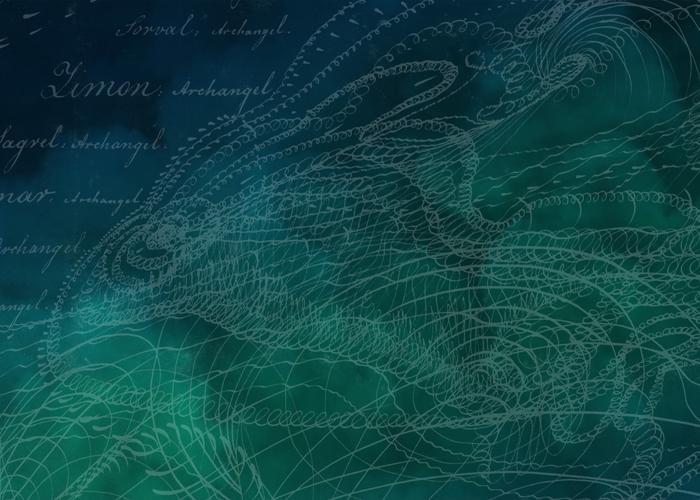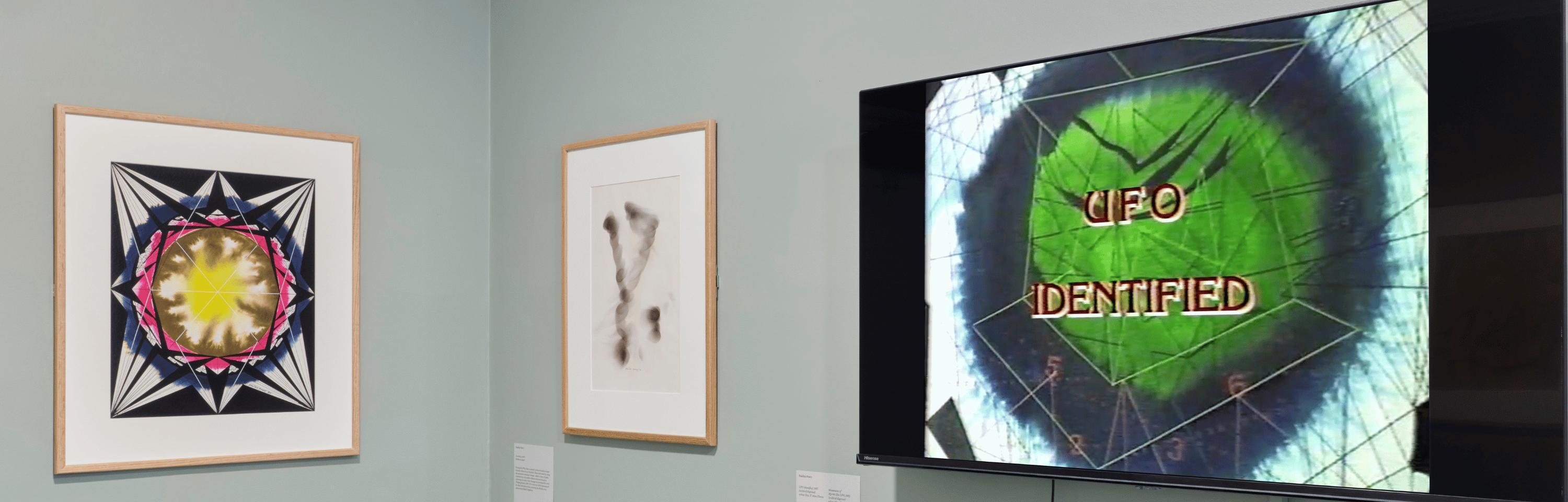
Paulina Peavy (1901–99) was a visionary artist, teacher, gallerist, and medium whose work was shaped by contact with a spirit entity named Lacamo—an extraterrestrial being she first encountered during a séance in the 1930s. Lacamo remained a lifelong collaborator, guiding Peavy's artistic process and spiritual worldview. Trained in Los Angeles, Peavy was active in early abstract and occultist art circles, exhibiting widely in the 1930s and 1940s. She later moved to New York, where she continued her multidisciplinary practice across painting, drawing, writing, and film. Peavy envisioned a utopian future brought about through the dissolution of gender, believing humanity would evolve toward an androgynous state of higher consciousness. The 'Paulina Peavy' room focused on her experimental works on paper and film, created as transmissions of her radical message.
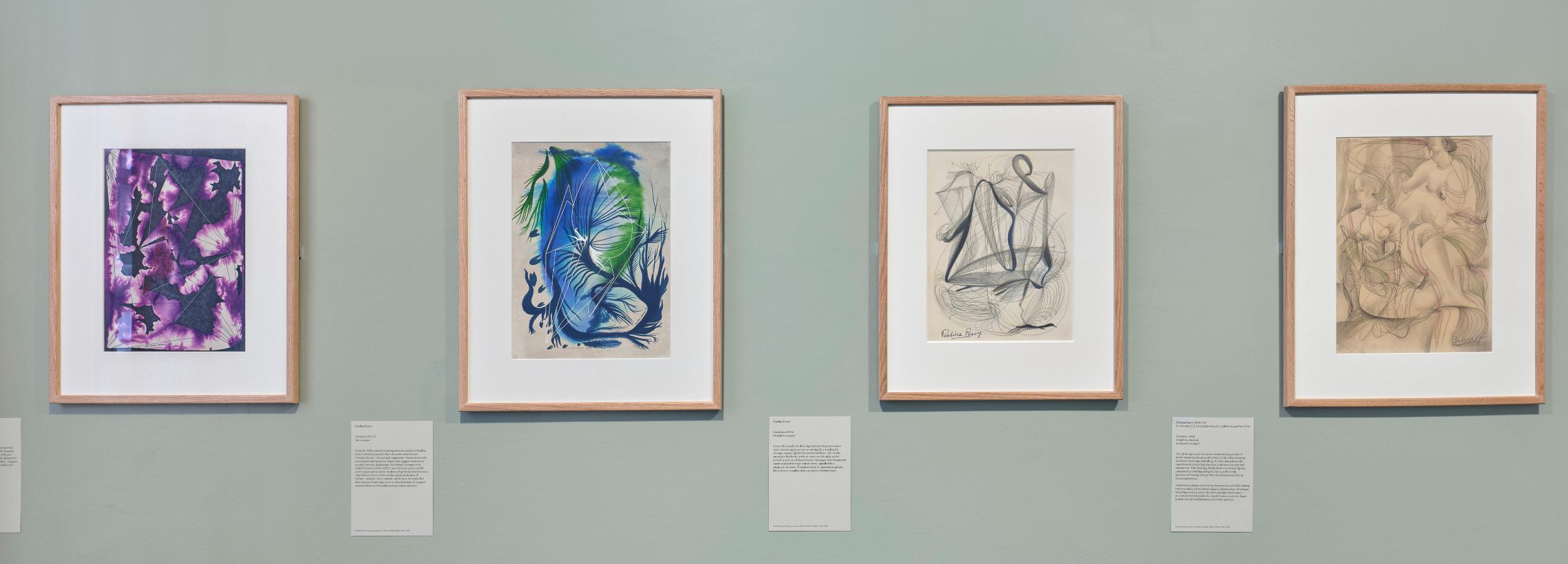
Peavy often made her drawings and paintings in a trance
state, describing her pencil as moving 'in a wondrously
strange manner,' guided by an external force. Her works
emerged effortlessly, without conscious thought, as she
moved in and out of altered states. Messages were frequently
communicated through sound waves, signalled by a
ringing in her ears. Though abstract in appearance, pieces
like Untitled, c.1940s, below left, may visualise those energetic transmissions.
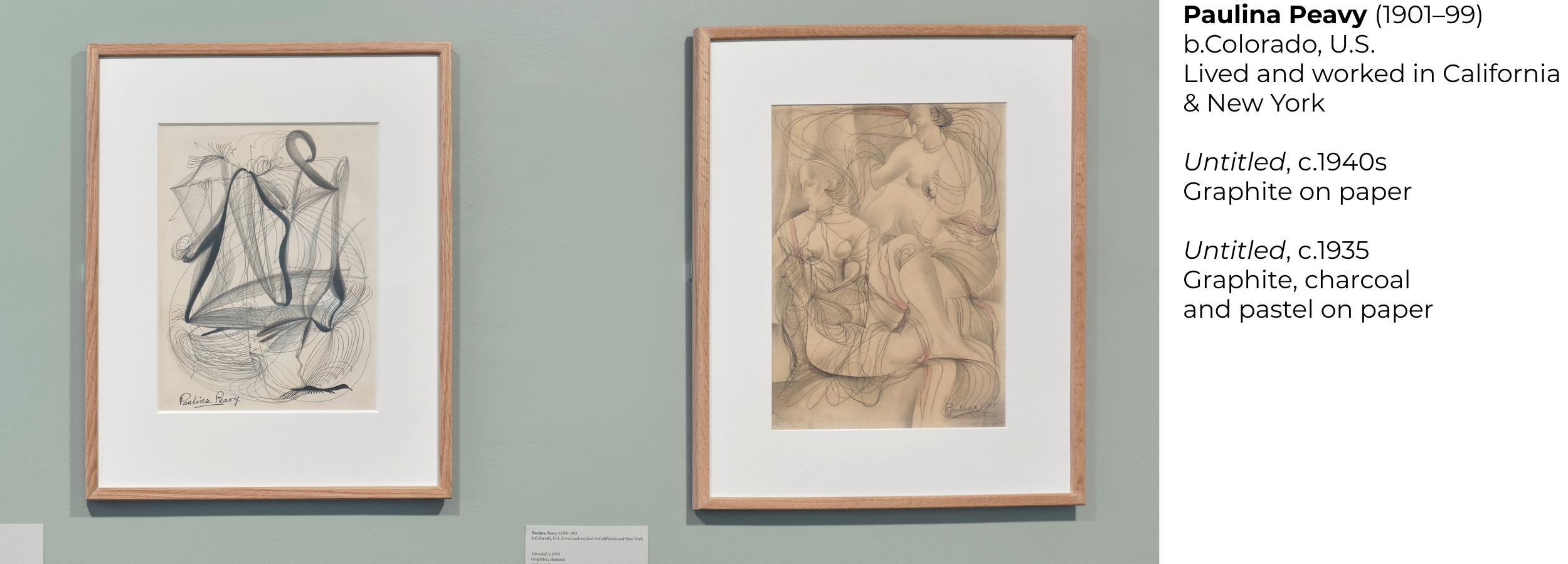
Untitled, c.1935, above right, is part of a series created during a time of profound personal upheaval in Peavy's life. After escaping an abusive marriage and falling ill with tuberculosis, she experienced visions that she later understood as spiritual encounters. This drawing, which shows two female figures, connected by swirling energetic forms, reflects the presence of 'strange beings' that she encountered during these experiences. Amid the hardships of the Great Depression and while raising two sons alone, Peavy found solace in Spiritualism. She began attending séances, where she first encountered Lacamo—an extraterrestrial guide who would become a central figure in both her spiritual journey and artistic practice.
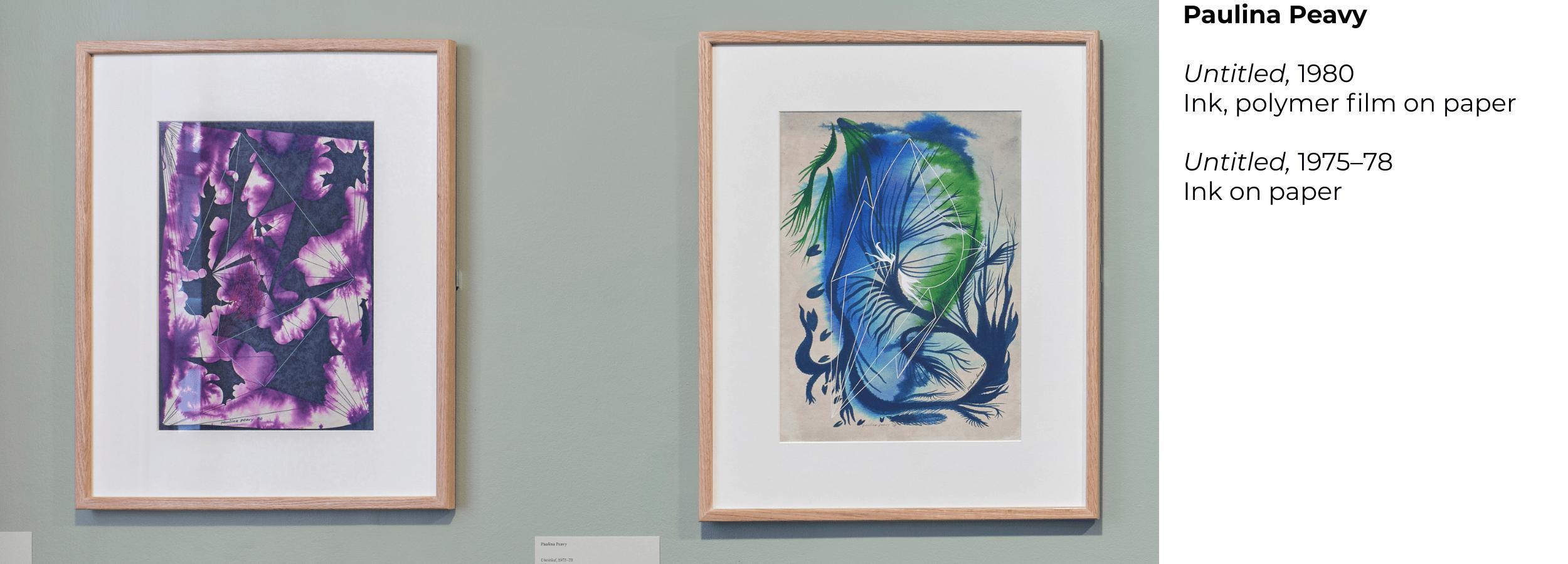
From the 1950s onward, drawing became central to Paulina Peavy's artistic practice. Her ink works often feature botanical forms—flowers and vegetation—interwoven with ectoplasmic and energetic shapes that suggest connective strands between dimensions. Her beliefs resonate with Rudolf Steiner's (1861–1925) view of plants as the Earth's sense organs and as active conduits of spiritual consciousness. Like Steiner, Peavy believed that spirit permeates all realms—mineral, plant, animal, and human. In works like Untitled, 1975-78, abstract forms may serve as visualisations of energetic transmissions and interdimensional communication.
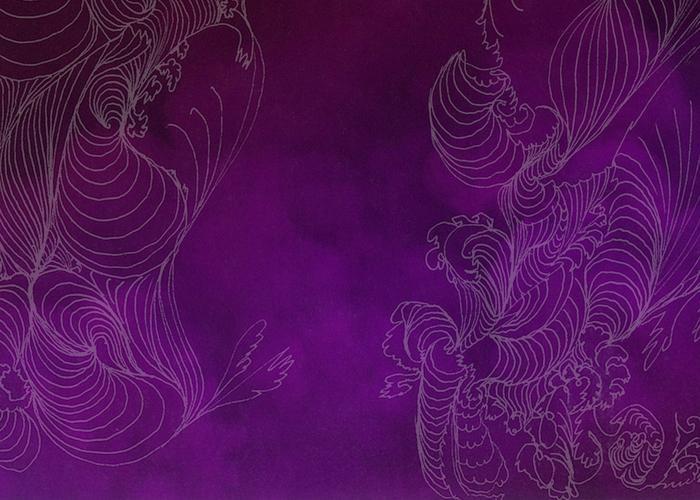
By the 1980s, Peavy's drawings had evolved to incorporate experimental techniques and collage. In Untitled, 1980, above, she combines fluid, tie dye-like ink backgrounds with precisely cut red polymer lines and hand-drawn white geometric forms. These shapes—floating over the inky surface—suggest maps of invisible energetic fields, acting as interstellar and interdimensional guides.
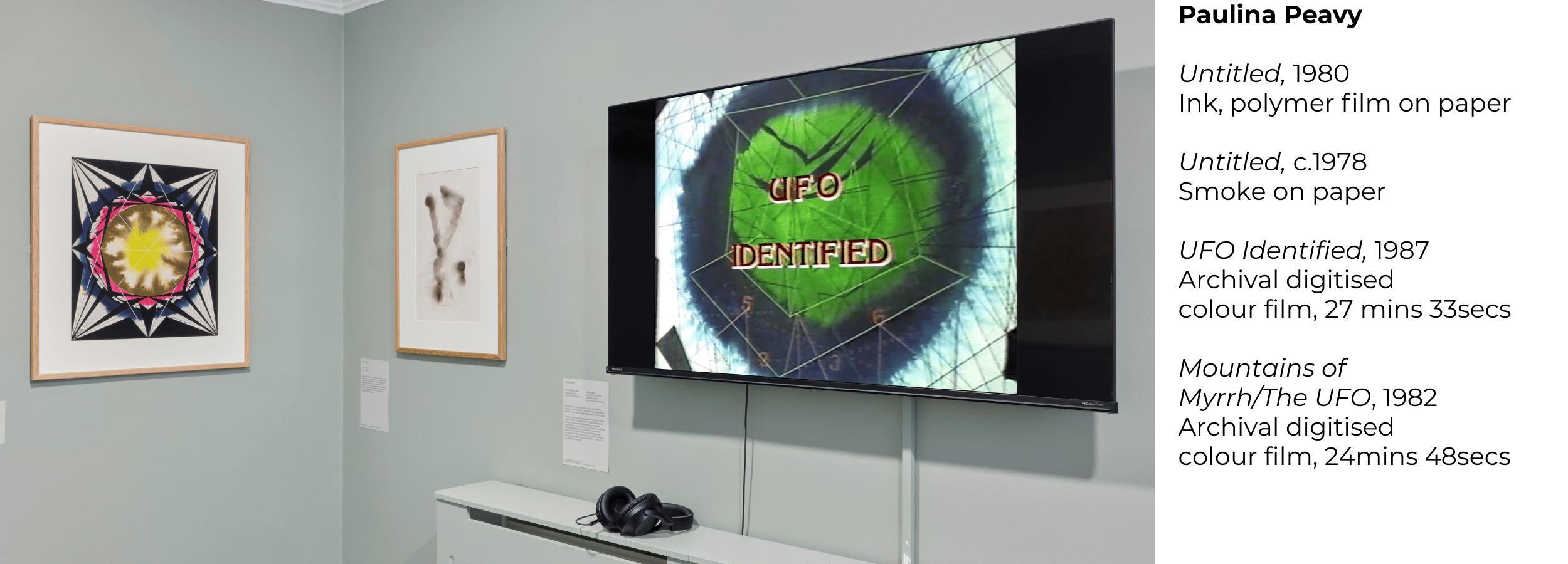
During the 1970s, Peavy created a series of works on paper that she referred to as 'Smokies' (above, centre). These were made by using the automatic technique fumage—where a sheet of paper is passed over a lit candle without conscious direction, capturing its smoky trails. Fumage was developed by artist Wolfgang Paalen (1905–59) in the mid-1930s and adopted by other Surrealist artists, including the British artist and occultist Ithell Colquhoun.
Paulina Peavy began making films in the early 1980s to visualise her radical belief in humanity's spiritual evolution through contact with UFOs and higher-dimensional beings. Using her own drawings, paintings, and sculptures—sometimes overlaid with transparencies of Egyptian pyramids and figures—she created kaleidoscopic compositions voiced by actors and accompanied by evocative soundtracks. UFO Identified features Peavy herself introducing her belief that UFOs are world saviours, guiding humanity into a new era: 'They always have been with us as they are the sequel to our mortal state,' she explains. 'Their plane is a step beyond… heaven.'
All photos: Eva Herzog. Artworks: Paulina Peavy Estate, courtesy Andrew Edlin Gallery, New York
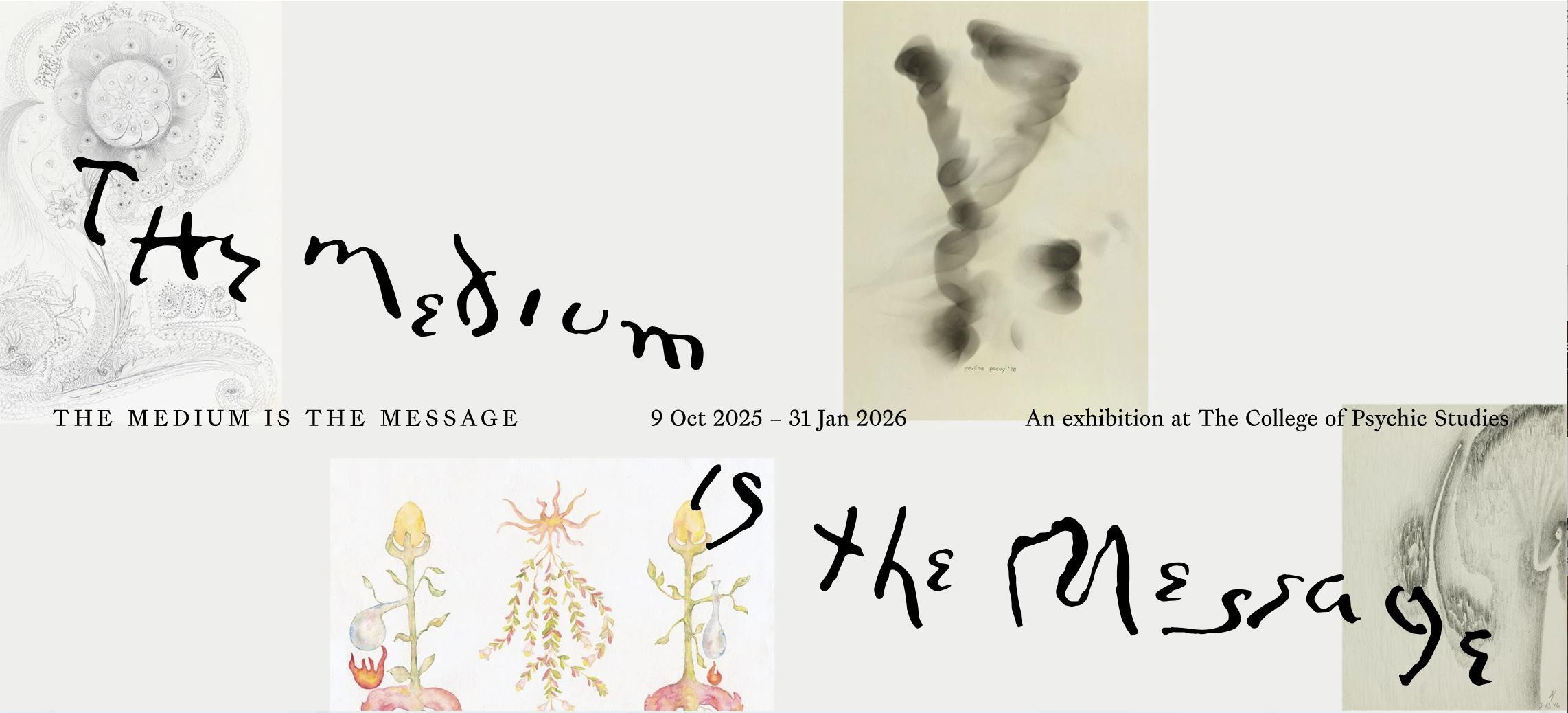
The Medium is the Message, 9 October 2025 –31st January 2026, was a major exhibition that explored the rich and complex relationship between artistic practice and mediumship.
Marking the centenary of The College of Psychic Studies' move to its historic home at 16 Queensberry Place in 1925, the exhibition spanned four floors and featured over 100 artworks alongside rare archival materials. It brought together more than 30 artists from the mid-19th century to the present day, examining how artists have visualised supernatural connection and imagined radical futures shaped by the ghostly and the unseen.
The Medium is the Message considered the artist as a channel between worlds – as a receiver of visions, energies and ideas. It highlighted the enduring role of mediumship within the College's history, with particular focus on the vital contributions of women – as artists, mediums, and feminist visionaries.
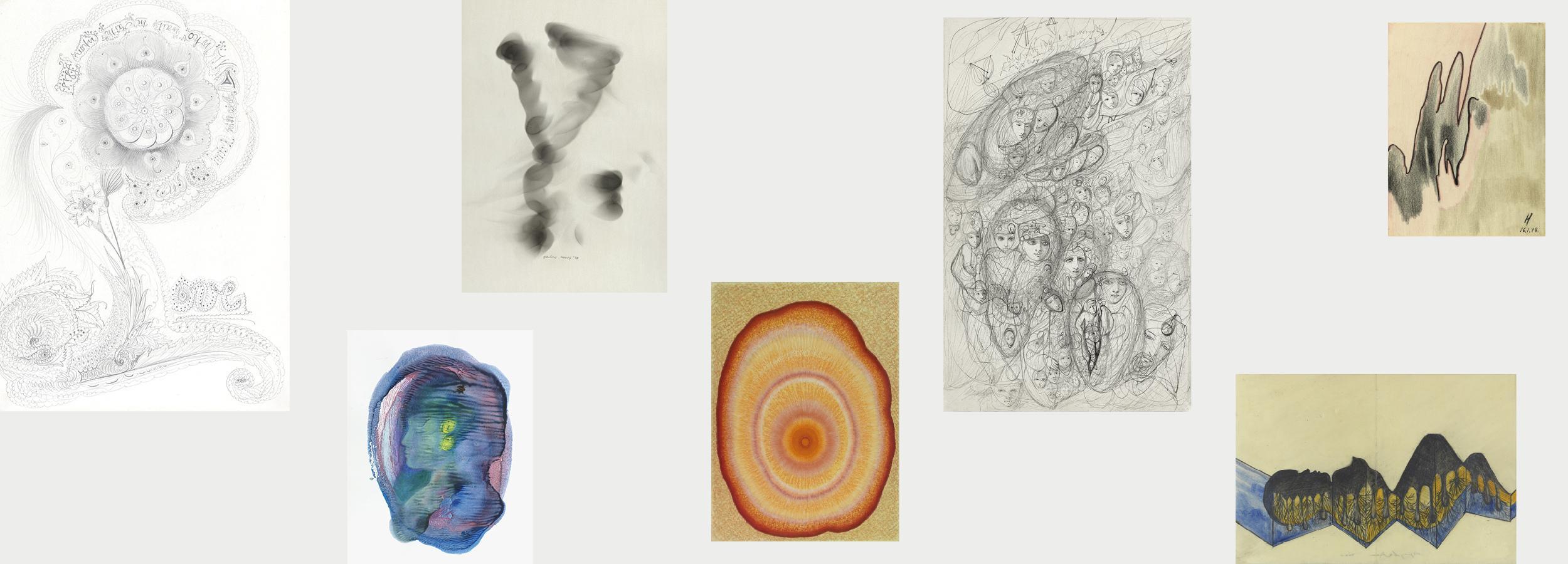
The exhibition included newly acquired works by Ithell Colquhoun, Aleksandra Ionowa, Sidney Manley, Ethel Le Rossignol, Anna Mary Howitt Watts and others alongside the first UK presentation of American visionary artist Paulina Peavy. These were shown in dialogue with works by contemporary artists including Sandra Vásquez de la Horra, Chantal Powell and Samir Mahmood, engaging with themes of spirit communication, ancestral memory, and the energetic connection between the body, Earth, and unseen realms.
Participating artists:
Mary Bligh Bond, Ann Churchill, Ithell Colquhoun, Joseph Crépin, Daniel, Dronma, Nicole Frobusch, Madge Gill, Anna Hackel, Stanislav Holas, Alme Hordijk, Frederick Hudson, Aleksandra Ionowa, Louise Janin, Freda Köhler, Augustin Lesage, Susan MacWilliam, Cara Macwilliam, Samir Mahmood, Sidney Manley, Margot, Cecilie Marková, Allen Moore o2o, Alice Essington Nelson, Heinrich Nüsslein, Paulina Peavy, František Jaroslav Pecka, Alice Pery, PIC, Chantal Powell, Victoria Rance, Arild Rosenkrantz, Ethel Le Rossignol, Victorien Sardou, Austin Osman Spare, Sarah Sparkes, Shannon Taggart, Mimei Thompson, Sandra Vásquez de la Horra, Anna Mary Howitt Watts, Ethel Annie Weir, Ariela Widzer, among others.
The Medium is the Message was curated by Jacqui McIntosh, Curator & Archivist at The College of Psychic Studies.